1 1/8 cups milk (warm (if needed you can use regular milk))
1/4 cup sugar
2 1/4 teaspoons instant or active dry yeast (one package)
2 whole large eggs (beaten)
1 1/4 sticks unsalted butter (melted)
1 cup graham cracker crumbs ((about 1 sleeve))
3 1/2 cups all-purpose flour
1/4 teaspoon cinnamon
1/4 teaspoon salt
oil (for frying (I like using canola oil))
1/3 cup water
1/2 cup brown sugar
2 teaspoons vanilla
1/2 cup graham crackers (curmbs)
Instructions
In the bowl of your electric mixer (with the dough hook attached) add the sugar to the milk, stir to dissolve and add the yeast. Stir gently, then let sit for 10 minutes. Melt the butter in a separate bowl, add the beaten eggs, stirring constantly to make sure the butter is not too hot for the eggs. Add the egg/butter mixture to the yeast mixture. With the mixer on medium-low speed, allow the dough hook to stir this mixture for a couple of minutes, making sure it's thoroughly combined. With the mixer still going, add the salt, 1/4 teaspoon cinnamon, graham cracker crumbs, and flour in 1/2 cup increments until all the flour is gone. Stop the mixer, scrape the bowl down, then turn the mixer on the same speed again for five more minutes. After five minutes, stop the mixer and scrape the bottom of the bowl. Transfer the dough to a lightly oiled bowl and toss the dough to coat, then cover the bowl with plastic wrap and place straight in the fridge. Refrigerate dough for at least 8 hours, or overnight.
Remove bowl from fridge and turn out dough onto a lightly floured surface. Roll out to 1/4 to 1/3-inch thickness. Using a 1 1/2 to 3 inch cutter, cut as many rounds as you can, then roll out remaining dough and cut as much as you can. Place the doughnuts on a floured baking sheet and use a 1 inch cutter to cut out the the middle of the doughnuts. Cover with large towel and place in a warm place in your kitchen. Allow doughnuts to rise for one hour (mine were good to go after 50 minutes). Doughuts should be puffy and airy.
Make the glaze. In a small sauce pan, combine the water and brown sugar and bring to a boil over high heat. Simmer 1 minute and then remove from heat. Stir in the vanilla.
Heat about 2-inches of oil in a large, heavy bottomed pot over medium heat until a deep-fry thermometer reads 375 degrees F. Line a large plate with paper towels.
Working in batches, fry the doughnuts, turning once, until they are golden brown, about 2 minutes. Transfer the doughnuts from the oil with a slotted spoon or skimmer to the prepared pan. Cool. Repeat with remaining dough, taking care the oil comes back to the correct temperature between each batch.
When all the doughnuts have been fried dip each in the brown sugar glaze and then sprinkle with the graham cracker crumbs. Eat!
1 1/2 pounds boneless, skinless chicken thighs, trimmed and cut into 1-inch pieces
2 tablespoons salt-free Cajun seasoning (see Tip), divided
2 tablespoons olive oil, divided
1 link andouille sausage (3-4 oz.), sliced
1/2 cup diced celery
1 small onion, diced (1/2 cup)
2 cloves garlic, minced
1/2 teaspoon salt
1 (14 ounce) can diced tomatoes
1/4 cup tomato paste
1 cup low-sodium chicken broth
1 cup uncooked instant brown rice
Instructions
Preheat oven to 400 degrees F. Line a large rimmed baking sheet with parchment paper or foil.
Cut tops off peppers and carefully remove the core and seeds, taking care not to split the skin. Dice the pepper tops and set aside. Place the peppers on the prepared baking sheet; bake for 20 minutes. Remove from oven and let cool. Discard any accumulated liquid in the bottom of the peppers.
Meanwhile, season chicken on all sides with 1 Tbsp. Cajun seasoning. Heat 1 Tbsp. oil in a large skillet over medium heat. Add half of the chicken and cook, turning to brown all sides, 4 to 6 minutes. Transfer the chicken to a medium bowl with a slotted spoon. Repeat with the remaining 1 Tbsp. olive oil and the remaining chicken.
Add sausage to the now-empty skillet and cook, stirring occasionally, until lightly browned, 1 to 2 minutes. Add celery, onion, and the reserved diced pepper; cook, stirring often, until the onions are translucent, 3 to 5 minutes. Add garlic, the remaining 1 Tbsp. Cajun seasoning, and salt; cook, stirring, for 30 seconds. Add tomatoes and tomato paste; stir to combine, scraping any brown bits off the bottom of the pan. Add broth, rice, and the chicken with any accumulated juices; stir to combine. Bring to a boil. Reduce heat to maintain a simmer and cook, stirring occasionally, until the chicken has cooked through and the rice has softened, 5 to 10 minutes. Remove from heat and stir. Let stand, covered, until all liquid is absorbed, about 10 minutes.
Divide the chicken mixture among the peppers, spooning about 1 1/4 cups into each one and mounding it on top, if necessary. Bake until heated through, about 20 minutes.
1 teaspoon kosher salt + 10 cracks of freshly ground pepper
1/4 cup toasted sesame oil
1/4 cup reduced-sodium soy sauce
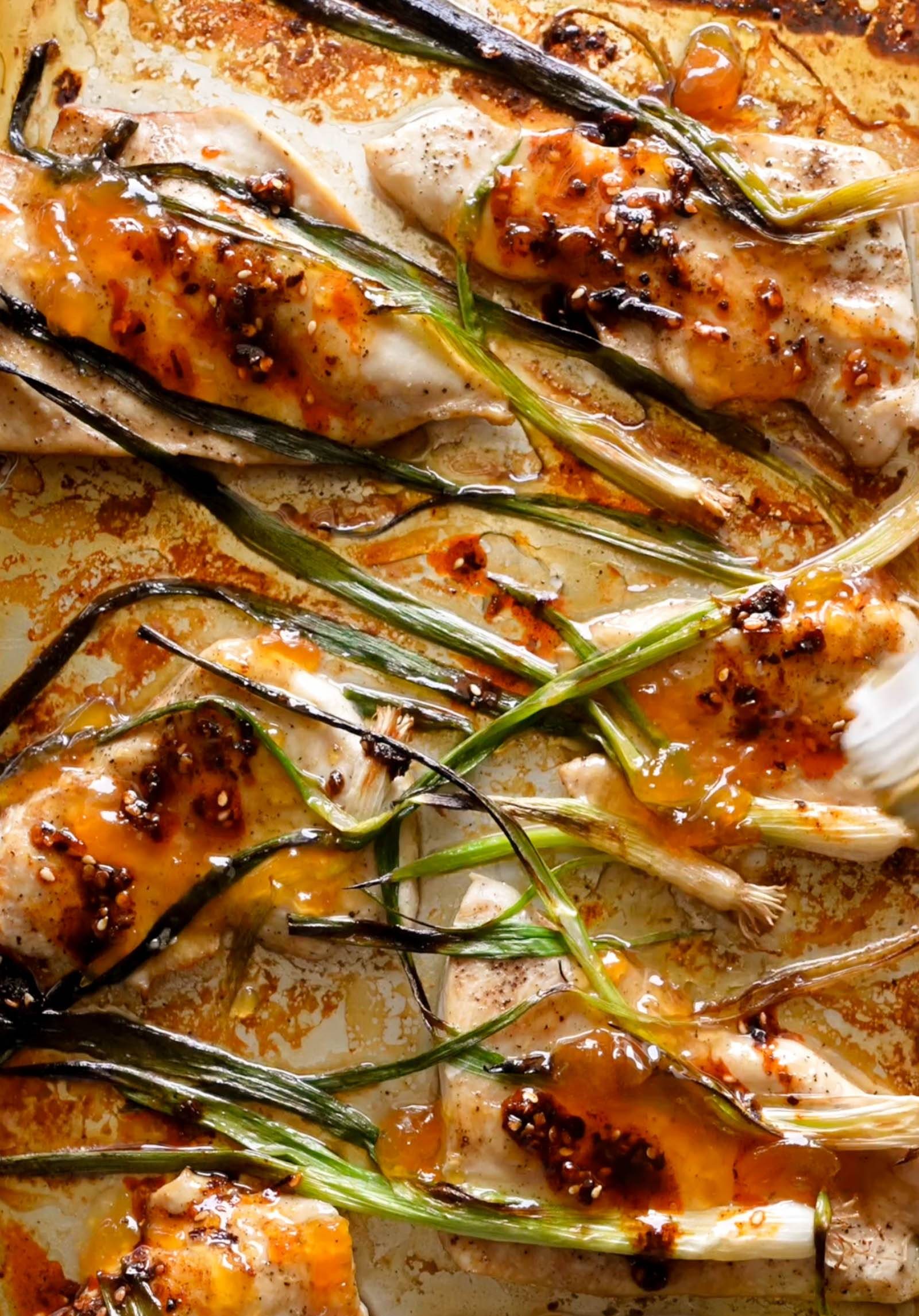
10 scallions, sliced in half lengthwise
1/4 cup apricot preserves
a few tablespoons of chili crisp
Rice
Any other vegetables – I like cucumbers
Instructions
Preheat the oven to 450 degrees. Place an oven rack in top 1/3 of oven.
Cut the scallions in half lengthwise.
Cut the chicken into thinner pieces horizontally. Place chicken on a sheet pan; season with salt and pepper. Drizzle sesame oil and soy sauce directly over the chicken.
Toss the scallions in some of the oil.
Place the scallions on top of the chicken. Bake for 6 minutes on the rack that is in the top 1/3 of the oven.
Turn the broiler on; broil for 1-2 minutes – the goal is to get the chicken cooked through (165 degrees) a small amount of charring on the scallions. There is tons of yummy flavor in those charred bits! Immediately spoon apricot jam and chili crisp over the top of each piece so it kind of melts in.
Serve chicken and a tangle of the charred scallions with rice, spooning extra pan juices over the top (or just drizzling with extra sesame oil and soy sauce). Humble method, max flavor!
1 lb. boneless skinless chicken breasts, cut into very thin strips
3 cloves garlic, grated
1 tablespoon olive oil
1-2 tablespoons lemon juice
1 teaspoon cumin
1 teaspoon smoked paprika
1 teaspoon kosher salt
1/2 teaspoon curry powder
black pepper to taste
2-3 bell peppers, sliced
olive oil and salt
3/4 cup full-fat plain Greek yogurt
1/2 cup grated cucumber (give them a quick squeeze over the sink to get rid of extra water)
1-2 tablespoons lemon juice
1-2 tablespoons olive oil
1 small clove garlic, grated
1 teaspoon dried dill
1/2 teaspoon kosher salt
pepper to taste
1 diced cucumber
1/2 diced red onion
1/2 cup kalamata olives
1/2 cup feta cheese
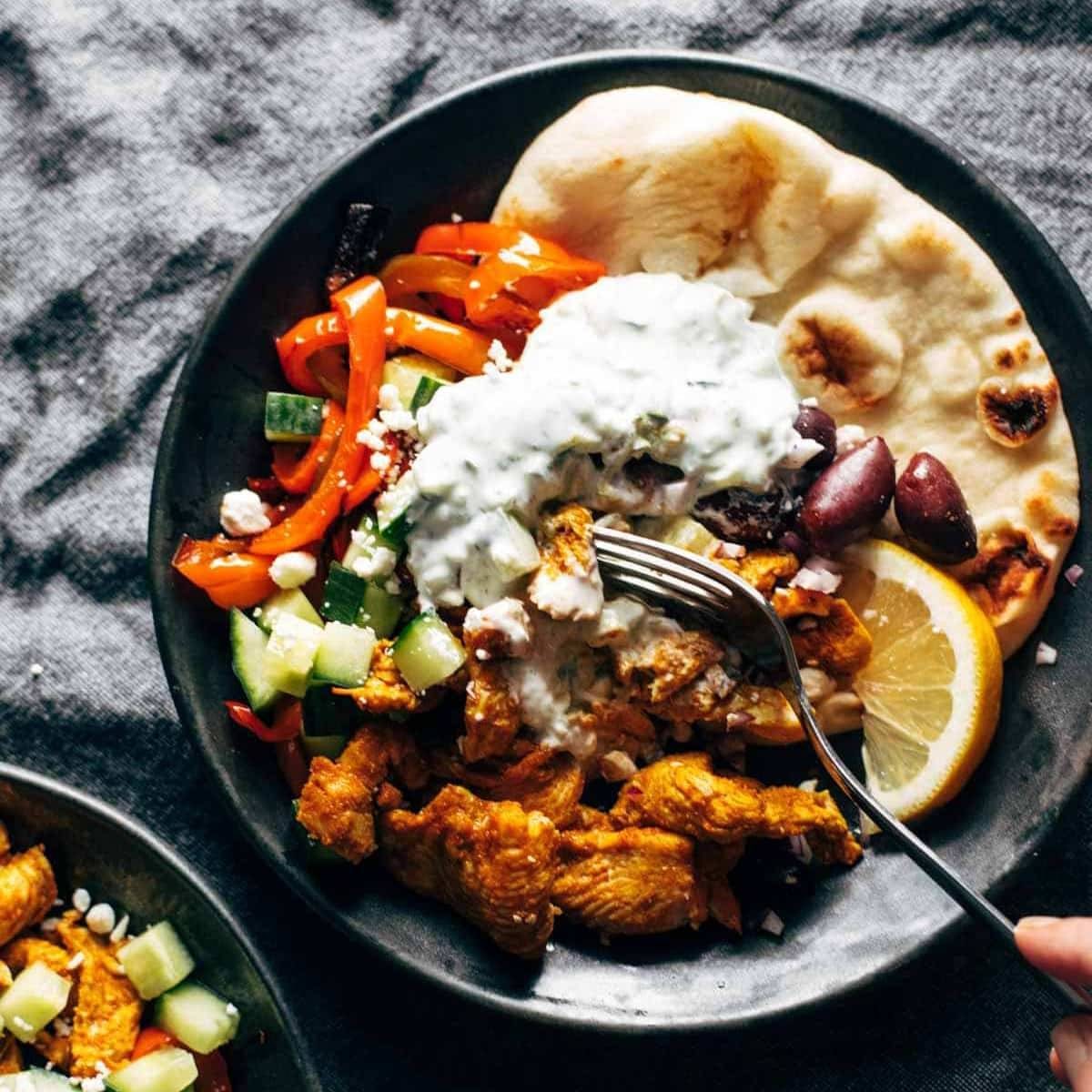
6 pieces of some kind of flatbread (pita, naan, socca)
Instructions
Preheat the oven to 425 degrees. Mix chicken ingredients in a bowl. Marinate for 30 minutes.
Mix all tzatziki ingredients.
On a sheet pan, toss the peppers with olive oil and salt. On a second sheet pan, place the chicken pieces. Roast both for 10-15 minutes, until chicken is cooked and peppers are browned.
Serve chicken, peppers, sauce, and all the other fixings on a big platter (or just a sheet pan, really) and everyone can build their own pitas / bowls / salads. So much salty-briney-crunchy goodness.
16 ounces sliced mushrooms (portobello or white button mushrooms)
2 tablespoons avocado oil
2 tablespoons Cajun seasoning (if it has salt in it, you may want to add less of it just to make sure the mushrooms don’t get too salty – every brand is different)
salt and pepper to taste
1/2 cup mayo
1 small clove garlic, grated (even half a clove is plenty)
1-2 teaspoons horseradish sauce, to taste (I use Boar’s Head)
1-2 teaspoons lemon juice, to taste
salt, to taste
Big honking chunk of bread that you really love (I like Trader Joe’s caramelized onion focaccia for this)
Pesto rosso (optional as a second sauce)
Havarti cheese slices
Arugula tossed with olive oil and lemon
Instructions
Preheat the oven to 450 degrees. Toss the sliced mushrooms with the avocado oil and the seasoning on a sheet pan until well-combined. Roast for 20-25 minutes, until golden brown.
Mix all the sauce ingredients in a bowl until well-combined. Taste and season.
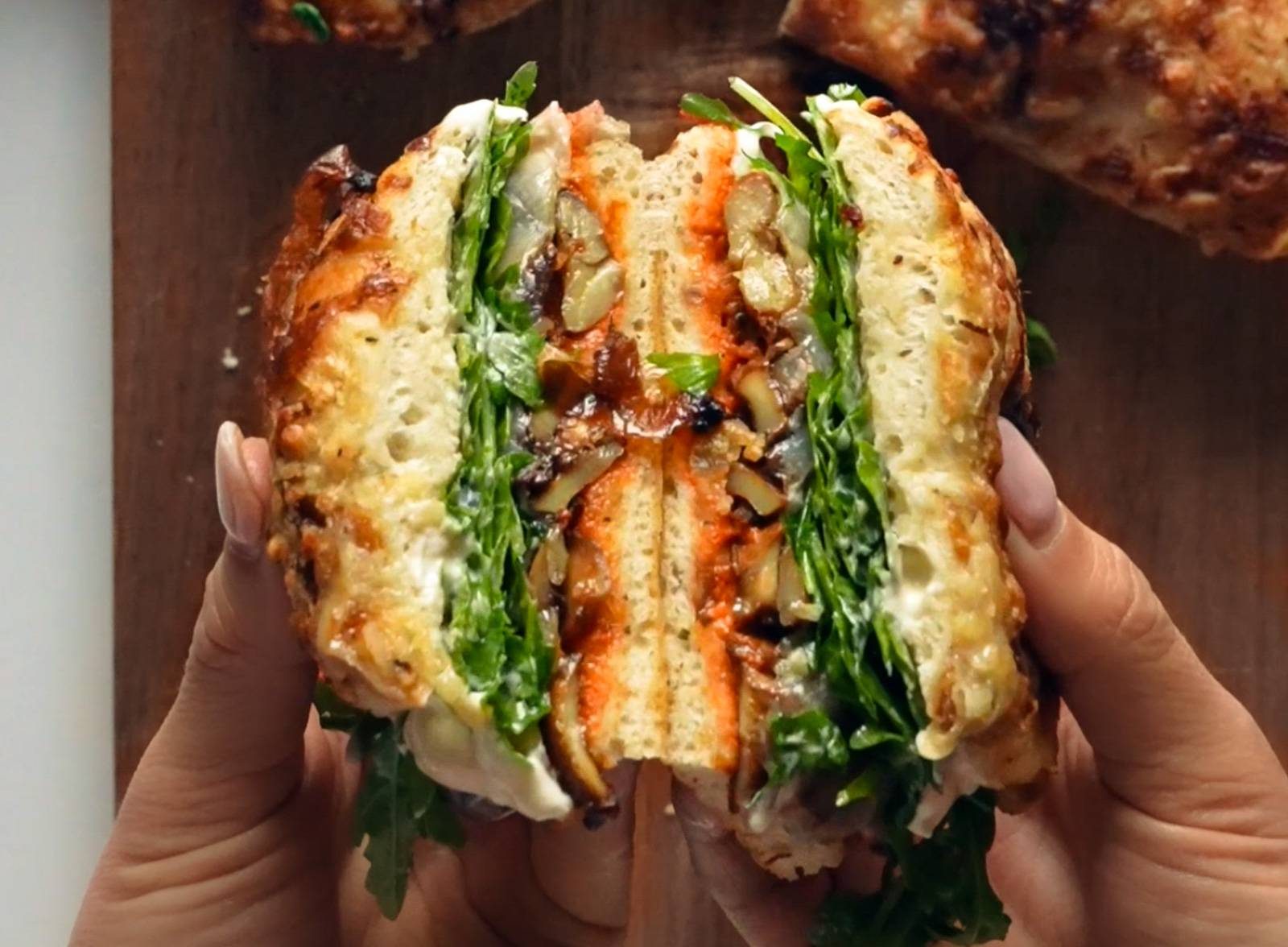
Toast the bread for the last few minutes on the pan with the mushrooms. Split the bread, spread with pesto rosso, roasty mushrooms, havarti (pop it in the oven again for a minute if you want it to melt), arugula, and the top piece of bread shmeared with the horseradish sauce. OH MY WORD can you even? This is so good.
2 tablespoons olive oil (Charlotte recommends avocado oil but I don’t normally have that on hand, so I used olive oil)
2 teaspoons Cajun seasoning, divided
2 tablespoons tomato paste
2 bags frozen cauliflower rice (10 oz. each, 20 oz. total)
sea salt and black pepper
1/2 lb. wild-caught shrimp, peeled and deveined, with tails on
2 tablespoons melted butter
fresh parsley, to garnish
lemon juice, to serve
Instructions
Preheat the oven to 425 degrees. Add the kielbasa sausage, onion, and bell pepper to a large sheet pan along with the olive oil and 1 teaspoon of Cajun seasoning. Toss the vegetables and sausage to make sure they are well-coated. Transfer the pan to the oven and cook for 10 minutes.
Remove the vegetables and sausage from the oven, add the tomato paste, and stir to thoroughly mix it in with the vegetables. Add the frozen cauliflower rice and remaining teaspoon of Cajun seasoning to the pan. Toss all the ingredients together until the are well-incorporated and return the pan to the oven. Continue to cook for 15-20 minutes, stirring occasionally, until the cauliflower rice is cooked through and most of the liquid has evaporated.
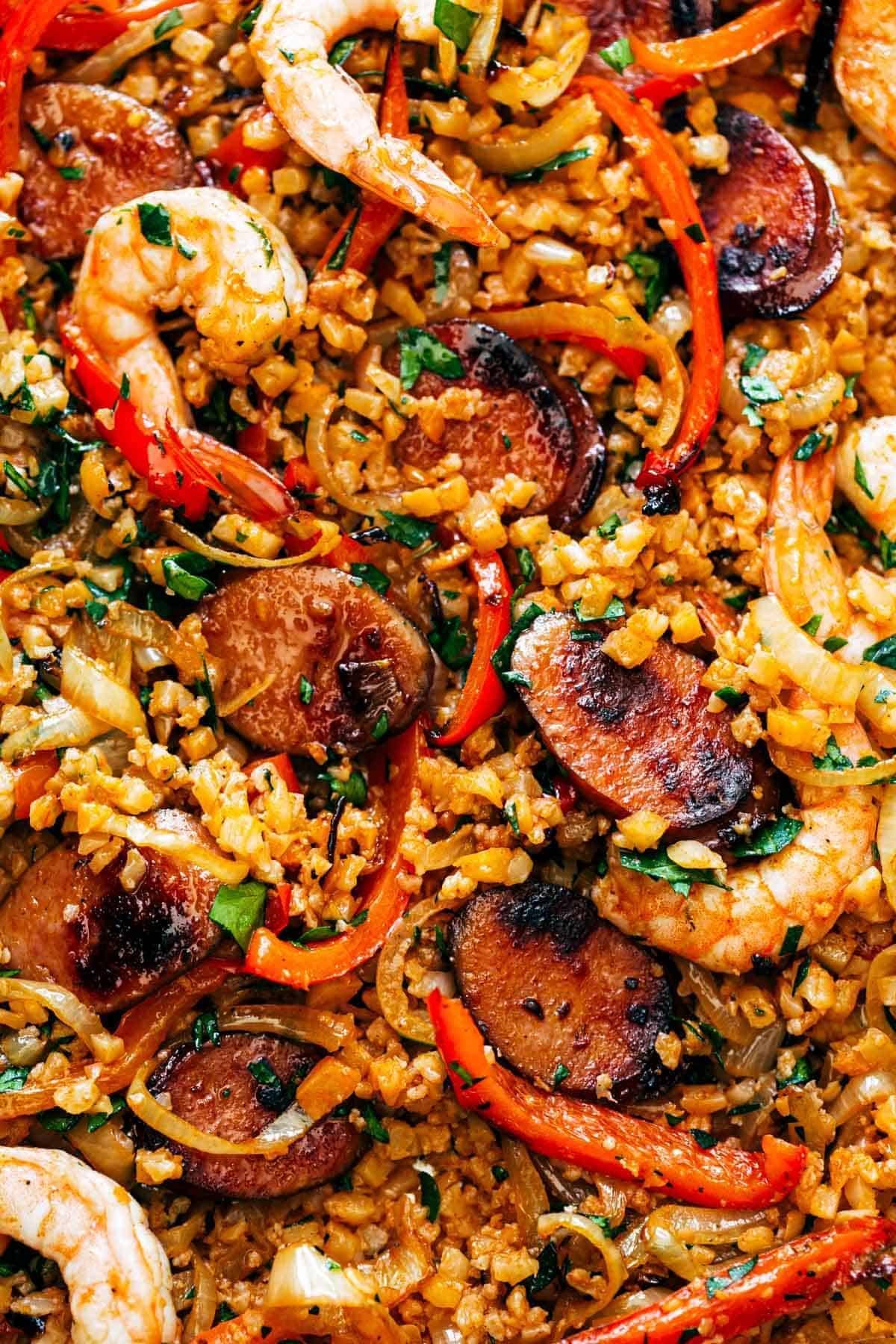
Taste the jambalaya and season with salt and pepper. Add the raw shrimp on top of the jambalaya and drizzle the butter over the top.
Return the pan to the oven and cook for 5-7 minutes, until the shrimp is cooked through and pink. Garnish with fresh parsley and a squeeze of lemon juice.
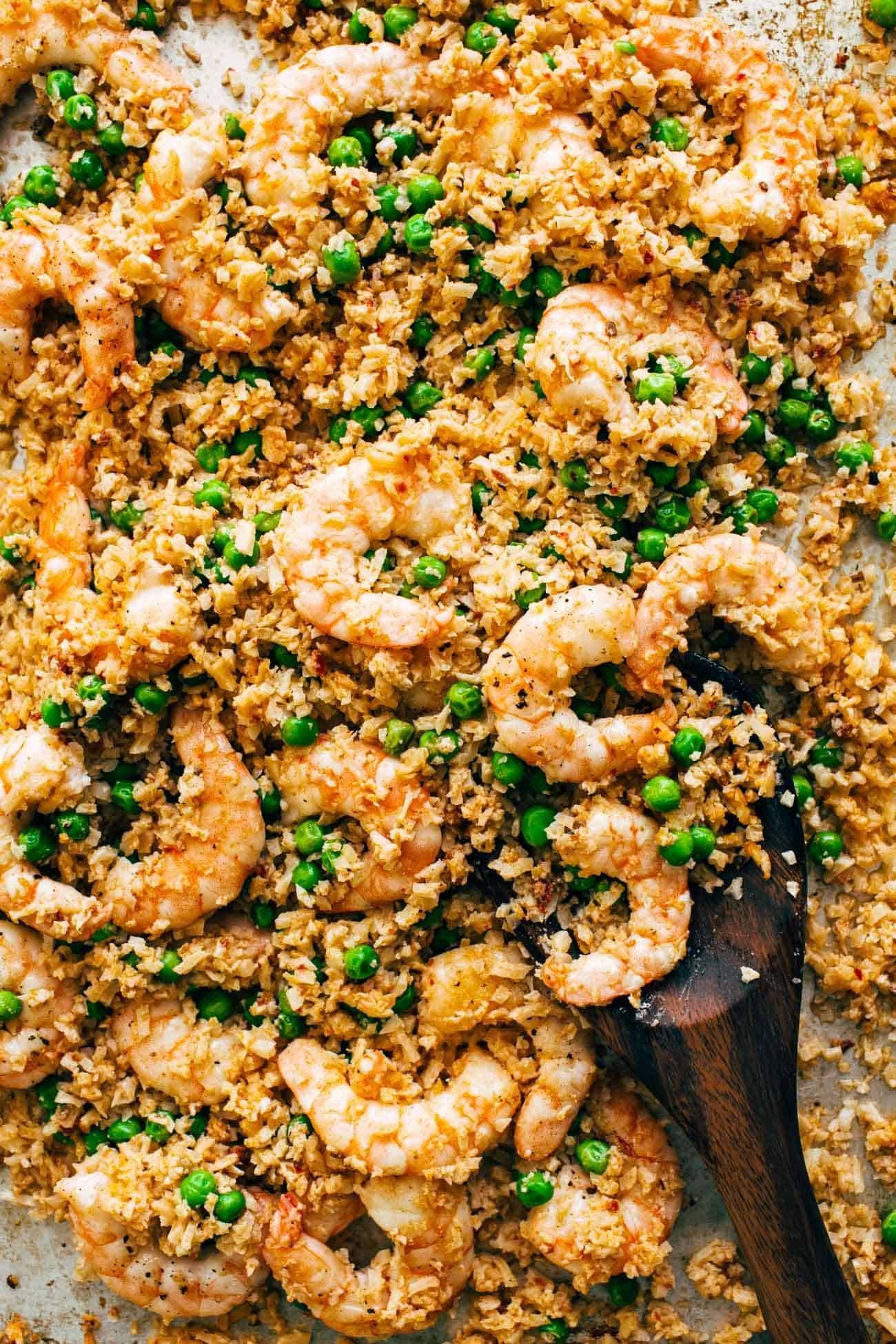
1 bag Season’s Choice Garlic Herb Riced Cauliflower (use 2 bags for a higher cauli-to-shrimp ratio)
2 tablespoons Prianno Rosso Pesto Sauce or similar sauce
1 lb. Fremont Fish Market Jumbo EZ Peel Raw Shrimp, tail off
1 cup Simply Nature Organic Frozen Sweet Peas
1/2 teaspoon garlic powder
2 tablespoons butter
up to 1/4 cup heavy cream (optional)
salt and pepper to taste
fresh lemon juice to taste
Instructions
Preheat the oven to 425 degrees. Mix cauliflower rice and pesto sauce directly on the sheet pan. Bake for 15-20 minutes.
Arrange shrimp and peas on top of cauliflower rice. Sprinkle shrimp with salt, pepper, garlic powder, and brush with butter. Bake for another 5-7 minutes.
Add cream and stir to combine, directly on the pan. (This makes it a bit more creamy, almost like a risotto.) Season with salt, pepper, and fresh lemon juice. Voila. Effortless.
2 teaspoons Cajun seasoning, such as Slap Ya Mama Cajun seasoning
1 tablespoon sweet paprika
1/4 cup creole mustard, spicy brown mustard, or Dijon mustard
2 teaspoons horseradish
3 tablespoons green onions, thinly sliced
1/2 cup celery, minced
1/4 teaspoon cayenne pepper, plus more to taste
Canola oil for frying, approximately 3-4 cups
3 pounds catfish fillets
2 cups yellow cornmeal
1 tablespoon Cajun seasoning
1 teaspoon cayenne pepper
4 large eggs
1 teaspoon water
2 loaves French bread
3 cups iceberg lettuce, shredded
1 cup dill pickle rounds
3 medium beefsteak tomatoes, sliced
1 medium onion, sliced into rings
Instructions
Set a baking rack over a sheet pan and set aside
In a small bowl, combine the mayonnaise, heavy cream, garlic powder, hot sauce, sweet relish, Slap Ya Mama seasoning, paprika, mustard, horseradish, green onions, celery, and cayenne pepper. Taste and add more cayenne pepper, if desired. Set aside until ready to use.
In a large bowl, combine the cornmeal, Cajun seasoning, and cayenne pepper. In another large bowl whisk to combine the eggs and water. Set the two bowls side by side. You will start with the cornmeal mixture.
Dip both sides of the fish into cornmeal mixture. Then, dip the fish into the egg mixture and let any excess drip off. Dip the fish back into the cornmeal mixture and coat both sides for a double coating. Set the breaded fish on the sheet pan lined with a baking rack until you are ready to fry. Repeat until all of the fish is coated.
Fill a large Dutch oven (or a heavy skillet) with at least 3 inches of oil in your pot and heat over medium-high heat, until the oil reaches 350°F on a thermometer.
Carefully put each fish filet into the hot oil. Fry the fish, until golden brown and crisp, roughly 3 to 4 minutes on each side, flipping halfway through cooking. This time can vary depending on the thickness of your fish, but you will be able to tell by the golden color on the outside.
Split open the French bread. Slather the remoulade on the inside of both sides of the bread. Layer the bread with lettuce, pickles, tomatoes, sliced onions, and fried fish. Assemble the remaining sandwiches. Cut sandwiches into desired portions.
Serve fish po’ boys with fries, chips, or a salad! Did you love the recipe? Give us some stars and leave a comment below!
1 cup self-rising cornmeal mix, such as White Lily
1 cup all-purpose flour
1 tablespoon Cajun seasoning
1 1/2 teaspoons kosher salt, or to taste (adjust based on the saltiness of your oysters and Cajun seasoning)
1 1/2 teaspoons freshly ground black pepper
2 to 3 quarts canola or vegetable oil, for frying
1/2 gallon (about 40) freshly shucked oysters, in liquid
French bread
Shredded lettuce
Dill pickles
Sliced tomatoes
Sliced white onions
Instructions
In a small bowl, stir together all of the remoulade sauce ingredients until combined. Set aside until ready to use. The sauce can be stored in an airtight container in the fridge for up to a week.
In a shallow bowl, combine the cornmeal mix, flour, Cajun seasoning, salt, and pepper. Whisk to mix. Line a sheet pan with paper towels and set nearby.
Add enough oil to reach 2 to 3 inches up the side of a large, deep cast-iron pot or Dutch oven. You should have at least 2 to 3 inches of space above the oil to prevent it from boiling over. Heat the oil over medium-high heat to 375°F.
Meanwhile, prepare the oysters. Remove a few shucked oysters from their liquid and briefly let them drip dry. Add them to the breading and toss to coat completely. Move them to a clean plate and repeat with the rest of the oysters.
When the oil comes up to temperature, carefully lower several of the oysters into the oil using a spider or slotted spoon. Don’t overfill the pot—the oysters should have plenty of room to cook without crowding each other. You will need to work in batches. Fry until golden brown and crisp, 3 to 4 minutes. Remove from the oil, drain, and place on the lined baking sheet. Repeat with the remaining oysters.
Split the bread in two (if needed) and spread the remoulade sauce on the top and bottom. Add the pickles and top with the fried oysters, sliced tomato, shredded lettuce, and sliced onion. Serve immediately. The remoulade sauce will keep for a week in an airtight container in the fridge. Love the recipe? Leave us stars below!
In a large stew pot set over medium heat, cook the diced bacon until crispy. Remove the bacon and set aside. (You'll add it back in when you serve your gumbo.)
Set the chicken thighs skin side down in the bacon fat to crisp. Salt the meat side, which will be facing up in the pot. Cook the chicken, without moving, for at least 4 to 5 minutes before turning the chicken over. Brown the other side of the chicken thighs. You start with skin side down to render some fat, which you will need for the roux. Remove the browned chicken thighs and set aside.
Brown the sausages in the fat, remove and set aside.
If you want, measure how much fat is in the pot; it should be about 1/2 cup. Or, do what I do and add 1/2 cup peanut oil to the pot. Let this heat up a minute or two, then stir in 1 cup flour. Stir this almost constantly for the first few minutes, then every couple minutes or so thereafter. Lower the heat to medium-low and cook this roux until it turns dark. How dark? I like my roux the color of coffee with just a tiny bit of cream. You can go all the way to chocolate brown, but be careful! If you burn your roux, you will need to start over and make it again. This whole process can take about 30 minutes.
While you are stirring and cooking the roux, bring the chicken stock and water to a boil in a separate pot.
Add to the roux the onion, green pepper and celery and mix well. Let this cook, stirring often, for about 5 minutes. Add the garlic, stir again and cook for another 2 minutes. Mix in the tomato paste.
Using a large ladle, add the hot chicken stock to the gumbo. It will sizzle and seize up as the roux absorbs the liquid. Keep adding more stock, stirring all the time and scraping the bottom of the pot, to incorporate all the stock and all the roux. You might not need all 2 quarts, but add enough to make the gumbo slightly more watery than you want it to be at the end. Remember, you are going to cook this down for several hours. Stir in half (3 tablespoons) of the Cajun spice mix, taste the gumbo, and add more if you want.
Lower the heat to medium-low and add back the chicken thighs. Now you can either eat the skin while it's still crispy, or toss it into the gumbo and chop it fine later. I tend to do half-and-half. Simmer this gently, stirring from time to time, until the meat wants to fall off the bones of the chicken, about 90 minutes. Remove the chicken and let it cool a bit.
While the chicken is cooling, cut the andouille sausage into thick discs and drop them into the gumbo. Add the okra. Pick the chicken meat from the bones and chop it roughly. Add it back into the gumbo. At this point, you can cook the gumbo for another hour or up to several more hours, depending on how cooked down you want the final stew to be.
When you are ready to eat, add the green onions, parsley and bacon and stir well. Serve over rice, or with good French bread. Did you love the recipe? Give us some stars and leave a comment below!
2 1/4 teaspoons (7 g or 1 package) active dry yeast
1/2 cup (115 g or 1 stick) unsalted butter, cut into cubes
2 large eggs
1/2 teaspoon kosher salt
1/2 teaspoon ground cinnamon
1/4 teaspoon ground nutmeg
1/2 teaspoon vanilla extract
1/4 teaspoon almond extract (optional)
3 to 3 1/4 cups (420 to 455 g) all-purpose flour
4 tablespoons unsalted butter, cubed
2/3 cup (145 g) packed dark brown sugar
1/2 teaspoon ground cinnamon
1/4 teaspoon ground nutmeg
1/4 teaspoon kosher salt
1 large egg yolk
1 tablespoon water
1 1/2 cups (175 g) powdered sugar
2 to 3 tablespoon milk
1 teaspoon vanilla
Purple, green and yellow colored sugar
1 tiny toy baby
Instructions
In a small saucepan set over medium-low heat, add the milk and honey and stir constantly until the milk is warm and the honey has dissolved. Remove the milk from heat. When it’s warm to the touch but not hot (about 100°F), sprinkle the yeast over the milk and stir. Set aside for 5 minutes until small bubbles start to form. If bubbles do not form, discard and start over with new yeast.
In a small microwave-safe bowl, add the cubed butter. Cover the bowl and microwave the butter for 30 to 45 seconds, or until the butter is mostly melted. Some solid chunks are ok.
Into a large bowl or the bowl of your stand mixer add the milk mixture and butter, making sure to scrape down the sides and bottom of the bowl. Add the eggs, salt, cinnamon, nutmeg, vanilla, and almond extract (if using). Beat together with a whisk until blended, about 5 to 10 seconds on medium speed if using the mixer whisk attachment, or by hand. You just want to bring it together a bit.
Switch the attachment on your stand mixer to the dough hook. Add 3 cups flour and set the stand mixer to low until the flour has absorbed into the liquid. Increase the speed to medium and mix until a rough dough forms and pulls away from the sides of the bowl. Knead the dough with the hook for 5 minutes until a smooth supple dough forms. The dough will be fairly soft, and a little tacky but not sticky. If the dough seems too wet as you knead it, add a little more flour, 1 tablespoon at a time. The dough should be pliable and not so sticky that you can’t handle it.
Lightly grease a bowl so the dough doesn’t stick. Stretch and form the dough into a smooth ball. Place the ball in the bowl, cover with plastic wrap and let sit in a warm place for 1 hour or until it has doubled in size.
About 10 minutes before the dough has finished rising, make the filling. In a medium microwave-safe bowl, add the butter and cover the bowl. Set the microwave for 30 to 45 seconds. You want the butter melted completely. Add the brown sugar, cinnamon, nutmeg, and salt to the melted butter. Stir until a thick paste forms. Cover and set aside until you’re ready to use.
Line a rimmed baking sheet with parchment paper or a silicon baking pad. Once the dough has doubled, turn it out onto a clean work surface. Use a rolling pin to roll the dough into a large rectangle, about 10x24 inches wide. The dough will be pretty thin, about 1/4 to 1/2 inch thick. Using a small offset spatula, butter knife, or silicon spatula, spread a thin layer of cinnamon sugar filling over the dough, leaving 1 inch at the top of the rectangle bare (the long side). At first, it won’t seem like there is enough filling but keep spreading, scraping up any thicker areas. Eventually, you’ll be able to get a thin coating of the filling all over the dough. That’s what you want. Starting at the long side, roll the dough up to form a long, thin log. Pat and press the 1-inch bare dough border at the top to the log, making sure it seals. Turn the log so the seal is at the bottom.
Using a sharp knife, cut the log lengthwise, splitting the log in half. Twist the two halves together, making sure the cut “strip” side is facing upward. Move the twisted rope to the prepared baking sheet and form a ring. Tuck the ends of the dough under each other to help seal the ring together.
Cover the ring with plastic wrap and leave it in a warm place to rise until puffy and almost double in size, about 45 to 60 minutes.
About 30 minutes into the second rise time, preheat the oven to 350°F.
Once the ring has risen, beat the egg yolk together with the water and gently brush it over the ring. Bake in the oven until the top is golden brown and sounds hollow when you tap it, 25 to 35 minutes. If you have an instant-read thermometer, it should read 195°F to 200°F in the center of the dough. Don’t worry if some of the filling has oozed out while baking, that’s totally normal.
Let the cake cool on the baking pan for 10 minutes, then loosen the bread from the pan with a spatula. Then carefully move the cake to a wire rack using two spatulas and let cool completely to room temperature. Once the cake has cooled, insert the baby into the cake (I usually push it in on the bottom so no one can tell where it is).
To make the glaze, sift the powdered sugar into a medium-sized bowl. Add 2 tablespoons of milk and the vanilla. Stir until the ingredients are fully incorporated and a glaze forms. The glaze should be thick and opaque but still pourable. If the glaze is too thick, add more milk, 1/2 teaspoon at a time, until the desired thickness has formed.
Place the wire baking rack with the cooled cake over a rimmed baking sheet. Spoon the glaze all over the cake making sure the top is completely covered. Then immediately sprinkle the colored sugar over the cake. The wet glaze will allow the sugar to adhere to the cake. Let the glaze and sugar dry, then move the cake to a serving platter. Did you love the recipe? Give us some stars and leave a comment below!
2 (15 ounce) cans kidney beans, drained and rinsed
2 (15 ounce) cans diced tomatoes
1 (15 ounce) can tomato sauce
8 small corn tortillas, sliced into strips
1 tablespoon olive oil
1 teaspoon chili powder
1/2 teaspoon kosher salt
Sour cream
Grated cheese
Chives
Instructions
In a large skillet set over medium-high heat, add the olive oil. Once it is hot, add ground beef and cook, breaking up the beef as it cooks, until beef is browned in spots, 7 to 8 minutes. Add onions, garlic, and spices and continue to cook for a few minutes to combine flavors. At the very end of browning, add beer or stock and use the liquid to scrape up any stuck bits from the skillet.
Transfer all the skillet ingredients to a slow cooker along with green chiles, beans, diced tomatoes, and tomato sauce. Cover the chili and cook on high for four hours, stirring occasionally, or set to low for 8 hours.
Season the chili with salt and pepper to taste once it has cooked. Serve it in big bowls garnished with cheese, sour cream, chives, and tortilla strips.
Preheat oven to 375°F. Slice tortillas into strips and spread them out on a baking sheet. Drizzle with oil and spices and use your hands to mix together. Spread out in an even layer and bake the strips for 5 to 6 minutes. Then stir strips to make sure they are cooking evenly. The ones around the edges will cook faster. Bake for 4-5 minutes and then remove from oven and cool. Tortilla strips will continue to get crispy as they cool.
1 1/2 cup long-grain rice (Carolina, basmati, jasmine, etc)
2 cups chicken broth
2 cups water
3 tablespoons extra virgin olive oil
1/2 pound ground pork
1/2 cup chicken livers
3 slices of bacon, chopped
1/2 onion, chopped
2 celery stalks, chopped
1/2 green bell pepper or 1-3 jalapeños, seeded and chopped
1 tablespoon Cajun seasoning
2 green onions, chopped
Instructions
Cook the rice according to the package instructions, but use chicken broth for one third of the cooking liquid. So, for example, if the package says to use 3 cups of water for 1 1/2 cups of rice, use 2 cups of water and 1 cup of chicken broth. Once the rice has finished cooking, remove from heat and let sit for 5 minutes. Turn the rice out onto a sheet pan and drizzle 1 tablespoon of olive oil over it. Mix to combine and let cool.
While the rice is cooking, mash and finely chop the chicken livers, or purée briefly in a blender.
In a large pan that can eventually hold the rice plus everything else, put 1 tablespoon of oil plus the bacon in and cook over medium-low heat until the bacon is crispy.
Add the ground pork and increase the heat to high. Allow the meat to brown before stirring. As soon as the pork starts to brown, add the final tablespoon of oil and add the celery, bell pepper or jalapeños, and onions. Brown them all over medium-high heat. You may notice the bottom of the pan getting crusty. Keep it from burning by lowering the heat if needed. Add the minced liver and cook for a few minutes more.
Add the remaining cup of chicken broth and deglaze the pan by scraping the bottom of the pan with a wooden spoon.
Add the Cajun seasoning and turn the heat to high. Boil away most of the chicken stock and then add the cooked rice. Toss to combine.
Toss once more to combine and serve hot. Did you love the recipe? Give us some stars and leave a comment below!

:max_bytes(150000):strip_icc()/6351610-b3467600d40c4668b44bafae4249a3f3.jpg)
:max_bytes(150000):strip_icc()/Simply-Recipes-Fish-Po-Boy-LEAD-07-c8df126346fa4c44b63fb386bd30a7f3.jpg)
:max_bytes(150000):strip_icc()/Simply-Recipes-Oyster-PoBoy-LEAD-04-bdebc6f8129e40f09bfccbc03b407dc6.jpg)
:max_bytes(150000):strip_icc()/__opt__aboutcom__coeus__resources__content_migration__simply_recipes__uploads__2011__08__chicken-gumbo-horiz-a-1600-1b68a859f0674b939c68b836243d8f3e.jpg)
:max_bytes(150000):strip_icc()/__opt__aboutcom__coeus__resources__content_migration__simply_recipes__uploads__2020__01__King-Cake-LEAD-8-90827feec3b74147adf25c4f9d07172f.jpg)
:max_bytes(150000):strip_icc()/__opt__aboutcom__coeus__resources__content_migration__simply_recipes__uploads__2020__10__SC-Beef-and-Bean-Chili-LEAD-2-c212e48f4ac048ea8ed961c516773378.jpg)
:max_bytes(150000):strip_icc()/Simply-Recipes-Cajun-Dirty-Rice-LEAD-03-b2be2acce76c4f40ba69842b75986c21.jpg)