63 recipes found
1. Preheat the oven to 450°F.
2. On a sheet pan, add the salmon, paprika, thyme, garlic powder, onion powder, salt, and pepper. Drizzle the olive oil over the salmon and toss to coat. Bake for 10-15 minutes until the salmon is crispy on top.
3. During the same time, make the breadcrumbs. Toss together the ciabatta, garlic, and a pinch of salt with butter slices. Bake for 10-12 minutes, until toasted.
4. To make the dressing. Combine all ingredients in a bowl and whisk until smooth. Taste and adjust the salt.
5. In a large salad bowl, mix the greens, basil, tomatoes, and cheese. Pour the dressing over the ingredients, then add the breadcrumbs, avocado, bacon, and salmon. Serve and enjoy!
Prep: Prep the tomato salad.
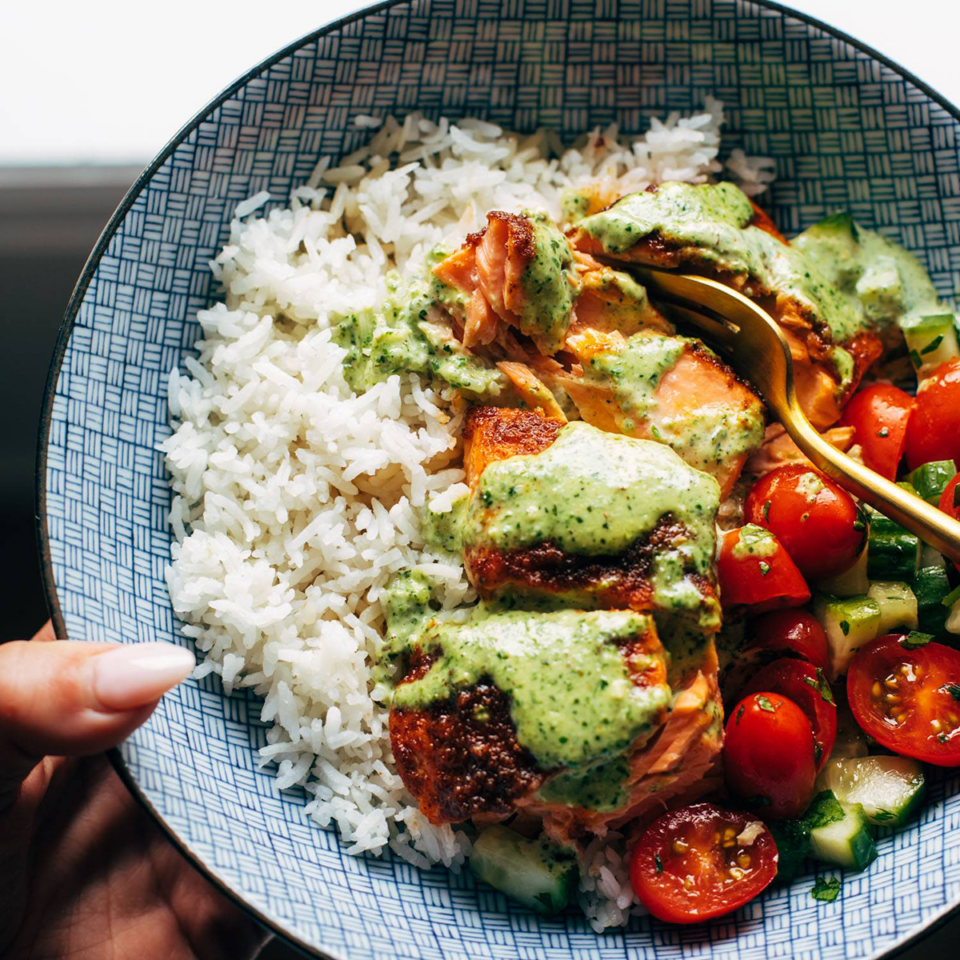
Make the basil sauce: Blend the basil sauce ingredients until almost completely smooth, with just a few flecks remaining.
Prep the salmon: Preheat the oven to 425 degrees. Mix the spices in a small bowl and stir in the olive oil. Coat the salmon with the spice paste.
Bake the salmon: Bake on a parchment-lined baking sheet for 9-12 minutes, or until 135 degrees in the thickest part. (It’s all personal preference, but this is the doneness that we like best – it’s a medium-well done salmon.)
Assemble the meal: Plate the salmon over the rice, serve with salad, and spoon the sauce over the top. Season with salt and pepp. Mwah!
Rinse rice in a sieve under cold water until water runs clear, about 1 minute. Bring rice and water to a boil over medium-high heat in a saucepan. Reduce heat to medium; simmer, covered, until rice is tender and water is absorbed, about 15 minutes.
Meanwhile, whisk together vinegar, sugar, and salt in a small bowl until sugar and salt dissolve. Drizzle vinegar mixture over hot rice; gently fold in. Cover surface of rice with a damp paper towel; let cool to room temperature, about 1 hour.
Halve cucumbers lengthwise, then cut each half crosswise into 4 equal pieces (for a total of 16 pieces). Trim a thin slice from the peel side of each piece (so the pieces will sit flat). Scoop out seeds from each piece, leaving a 1/3-inch border. Spoon 1 to 11/2 Tbsp. rice into each cucumber piece, then use damp hands to compact rice. Top each with salmon and avocado. Sprinkle with sesame seeds.
Serve with soy sauce, furikake, Kewpie mayonnaise, wasabi, and/or ginger.
Preheat the oven to 450 degrees F (230 degrees C). Line a baking sheet with parchment or foil.
Place salmon on the baking sheet; sprinkle with 1/2 teaspoon salt, pepper, lemon pepper, garlic powder, and paprika. Drizzle oil over salmon.
Bake in the preheated oven until salmon just starts to flake easily with a fork, 10 to 12 minutes. Let cool slightly before breaking up into small pieces. Reduce oven temperature to 400 degrees F (200 degrees C).
Meanwhile, combine rice, water, and remaining salt in a sauce pan. Bring to a boil, stir once, reduce heat to low, and cover. Cook until liquid is absorbed and rice is tender, 12 to 14 minutes. Transfer to a large bowl and fluff with a fork. Stir in rice vinegar and let cool.
When salmon is cooled, add it to a bowl with crab, cream cheese, 1/2 cup mayonnaise, 1 1/2 tablespoons Sriracha, and soy sauce, and stir to combine.
Lightly grease a 9x13-inch baking dish; add rice and press into an even layer. Crush nori sheets over rice and sprinkle with furikake. Spread salmon mixture over seaweed; sprinkle evenly with everything seasoning.
Bake at 400 degrees F (200 degrees C) until browned around the edges, about 25 minutes.
Stir remaining 1/2 cup mayonnaise, remaining 1 1/2 tablespoons Sriracha, and lime juice together. Drizzle over casserole before serving; top with green onions and avocado.
Prep: Preheat the oven to 425 degrees. Line a baking sheet with parchment paper.
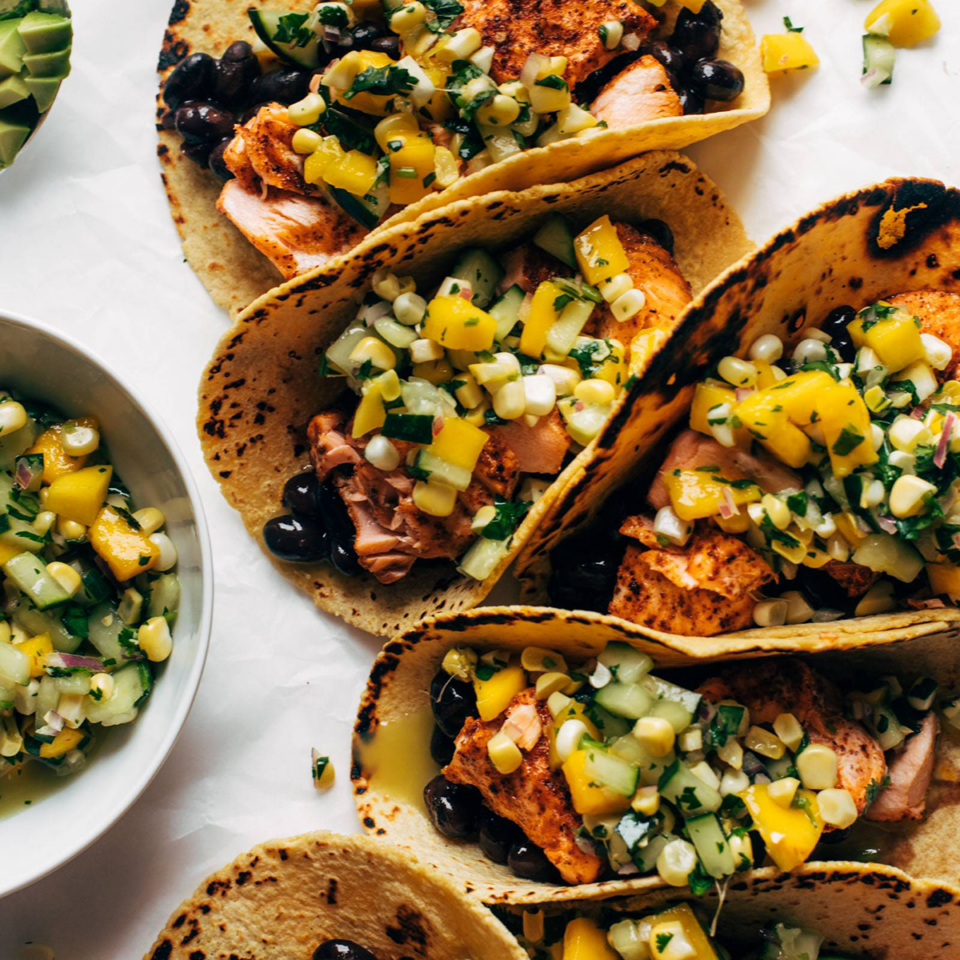
Season the Salmon: Toss the salmon with the taco seasoning and avocado oil until well-coated – you can do this in a bowl or directly on the baking sheet. If your taco seasoning does not have salt, add some salt to the salmon.
Bake the Salmon: Bake the salmon for 8 minutes, close to the top of the oven, or until it slips apart easily when pressed with a fork.
Make the Salsa: While the salmon is baking, chop up your salsa ingredients and toss together in a bowl. Season to taste.
Soften the Tortillas: To soften the corn tortillas, I usually heat up some oil in a large skillet and then give the tortilla a very quick one-sided dip into the hot oil and transfer to a paper-towel lined plate. I stack them up as I go so the heat and oil kind of distributes between all the tortillas. You can also wrap the tortillas in a few damp paper towels and microwave for 30 seconds to steam them so they become more pliable and yummy to eat.
Assemble the Tacos: Mash avocado or spread refried beans on the bottom of the tortilla. Add a couple pieces of salmon; press to gently smash them. Top with a big scoop of the salsa. I often finish these with lime squeezes and a drizzle of honey!
Line a large-rimmed sheet pan with parchment.
Toss the potatoes with 1 tablespoon of oil, 1/2 teaspoon salt, and 1/4 teaspoon pepper in a medium bowl.
Spread out onto the prepared sheet pan and roast for 15 minutes.
Meanwhile, toss the green beans with 1/4 teaspoon salt in the same bowl as the potatoes and set aside.
Once the potatoes have roasted for 15 minutes, add the green beans to the pan and toss with the potatoes. Push the vegetables to the sides of the sheet pan and add the salmon, skin-side down, to the center. Season the salmon with the remaining 1/4 teaspoon salt and 1/4 teaspoon pepper. Spread 2 tablespoons of the pesto on top of the fillets.
Roast until the potatoes are beginning to brown and are fork-tender and the salmon flakes easily with a fork, 12 to 14 minutes.
Mix the remaining oil and prepared pesto. Drizzle over everything before serving. Garnish with basil, if using, and serve with more pesto on the side.
Love the recipe? Leave us stars and a comment below!
Start the rice first and prep the rest of the ingredients while it cooks. Rinse the rice a few times under cool water, rubbing it gently with your hands, until the water isn't quite so cloudy. Then cook the rice according to package instructions or in a rice cooker. Fluff and keep covered until ready to eat.
Gently pat the salmon all over to make sure that there are no pin bones still lodged in the fillet; if there are, use needle-nosed pliers to remove them. Cut the salmon into 1/2-inch cubes. Add the salmon into a medium bowl and set aside.
:max_bytes(150000):strip_icc()/__opt__aboutcom__coeus__resources__content_migration__simply_recipes__uploads__2017__03__2017-04-26-PokeBowls-1-bef7322312ff46f59fb7cd05f5b6c775.jpg)
In a small bowl, stir together the soy sauce, rice vinegar, sesame oil, sugar and garlic powder. The garlic powder and sugar will not dissolve completely, but that's fine.
Add the sliced scallions to the bowl with the salmon, saving 1 to 2 tablespoons for garnish. Add the soy sauce mixture to the salmon and scallions. Using a large spoon or a rubber spatula, gently mix the salmon with the soy sauce mixture.
:max_bytes(150000):strip_icc()/__opt__aboutcom__coeus__resources__content_migration__simply_recipes__uploads__2017__03__30110741__2017-04-26-PokeBowls-10-02bc7b25c08947cb862147a910a50b93.jpg)
Divide the rice between each bowl and then the salmon. Top with the rest of the sliced scallions, sliced cucumber, sliced radishes, diced avocado, furikake and red pepper flakes, if you like. The poke bowl is best enjoyed immediately.
Did you love the recipe? Give us some stars and leave a comment below!
:max_bytes(150000):strip_icc()/__opt__aboutcom__coeus__resources__content_migration__simply_recipes__uploads__2017__03__30110735__2017-04-26-PokeBowls-8-46202459e03343a8b99a6178ed1e4ec0.jpg)
Set a nonstick skillet over medium high heat. Heat 2 teaspoons oil until it shimmers. Add salmon, skin side down. Brush with honey; sprinkle with salt and pepper. Cover and cook for 4 minutes.
Carefully flip salmon and reduce the heat to medium. Continue cooking until fish flakes easily with a fork, about 5 minutes more. Remove salmon to a plate or container; cover and refrigerate until very cold, at least 2 hours.
For dressing, crack an egg into a food processor. Add lemon juice, Worcestershire, Dijon, garlic, anchovies, grated Parmesan and black pepper; pulse to combine. With food processor running, drizzle in oil until mixture emulsifies. Refrigerate dressing until needed.
For croutons, melt butter in a heavy skillet over medium-high heat. Add bread cubes; sprinkle with Italian seasoning and granulated garlic.
Toast until croutons are browned, about 5 minutes. Remove from heat; set aside.
For salad, add lettuce to a large bowl. Flake salmon with a fork into bite-sized pieces and add to the bowl. Drizzle with Caesar dressing; top with croutons and shaved Parmesan.
1. Preheat the oven to 450° F.
2. On a baking sheet, toss the fish pieces with olive oil, honey, Tajin, paprika, garlic powder, onion powder, and a pinch of salt. Arrange in a single layer. Roast 10-15 minutes or until the fish is cooked to your liking. During the last minute, switch the oven to broil and broil until lightly charred. Set the fish aside.
3. To make the jalapeño cream. Combine all ingredients in a bowl. Season with salt.
4. To make the salsa. Combine all ingredients in a bowl.
5. Spread the cream cheese on the bottom of your shells. Layer in the lettuce, fish, and salsa.
1. Preheat the oven to 450° F.
2. Place the salmon on a baking sheet and rub with olive oil, honey, chili powder, paprika, garlic powder, onion powder, cinnamon, and a pinch of salt. To the pan, add the peaches, corn, jalapeños, and shallots. Roast 10-15 minutes or until the fish is cooked to your liking. During the last minute, switch the oven to broil and broil until lightly charred. Set the fish aside.
3. To make the salsa. Dice the peaches, remove the corn kernels from the cob, and chop the jalapeños and shallot. Add everything to a bowl with the avocado, cilantro, lime zest, and lime juice.
4. Melt together the butter and garlic. Cook until the butter is browning and the garlic crisps. Add chili flakes and salt, to taste.
5. Serve the salmon and salsa over bowls of rice. Drizzle the butter over the salmon and top with basil or cilantro.
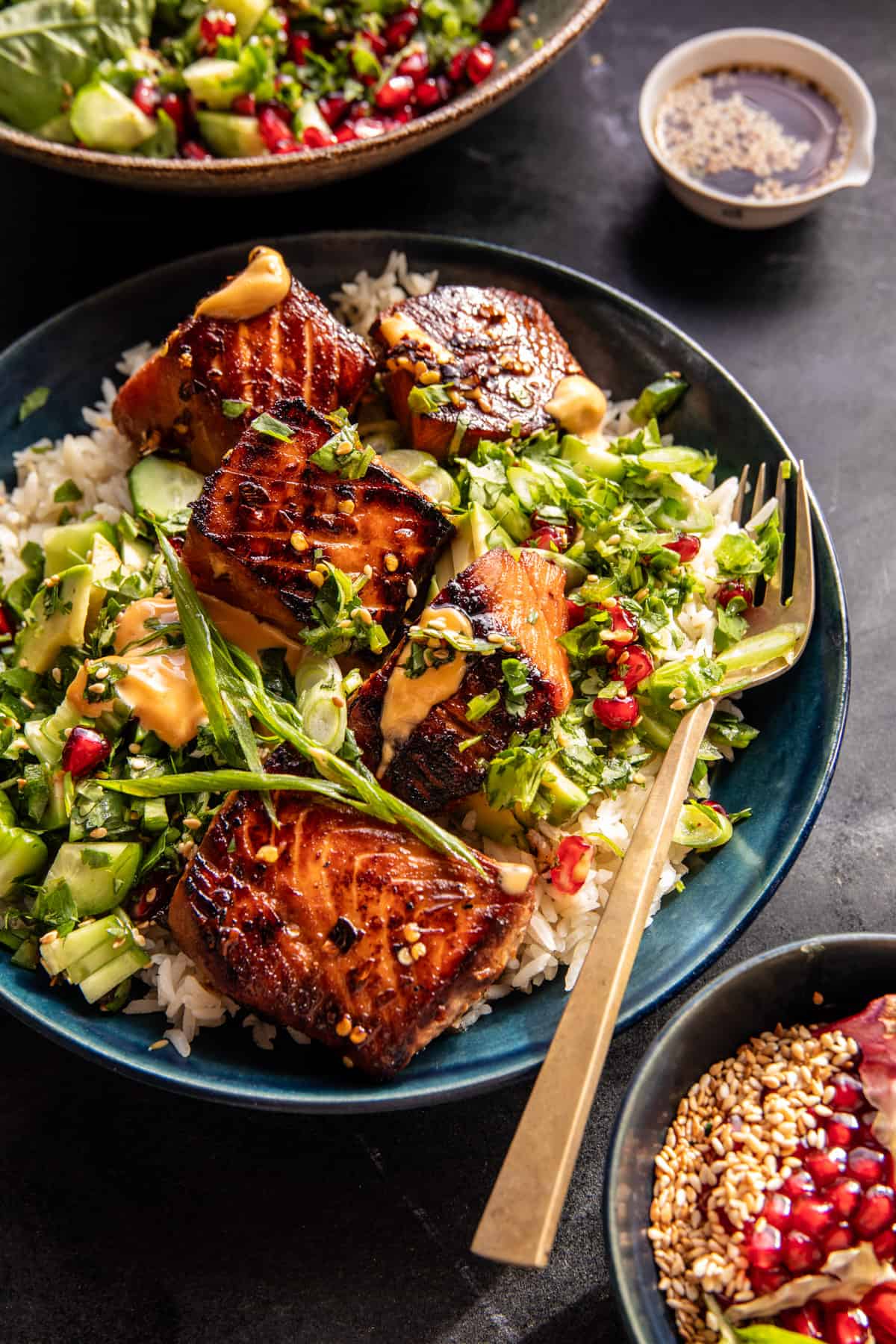
1. Preheat the oven to 450° F. Grease a baking sheet with olive oil.
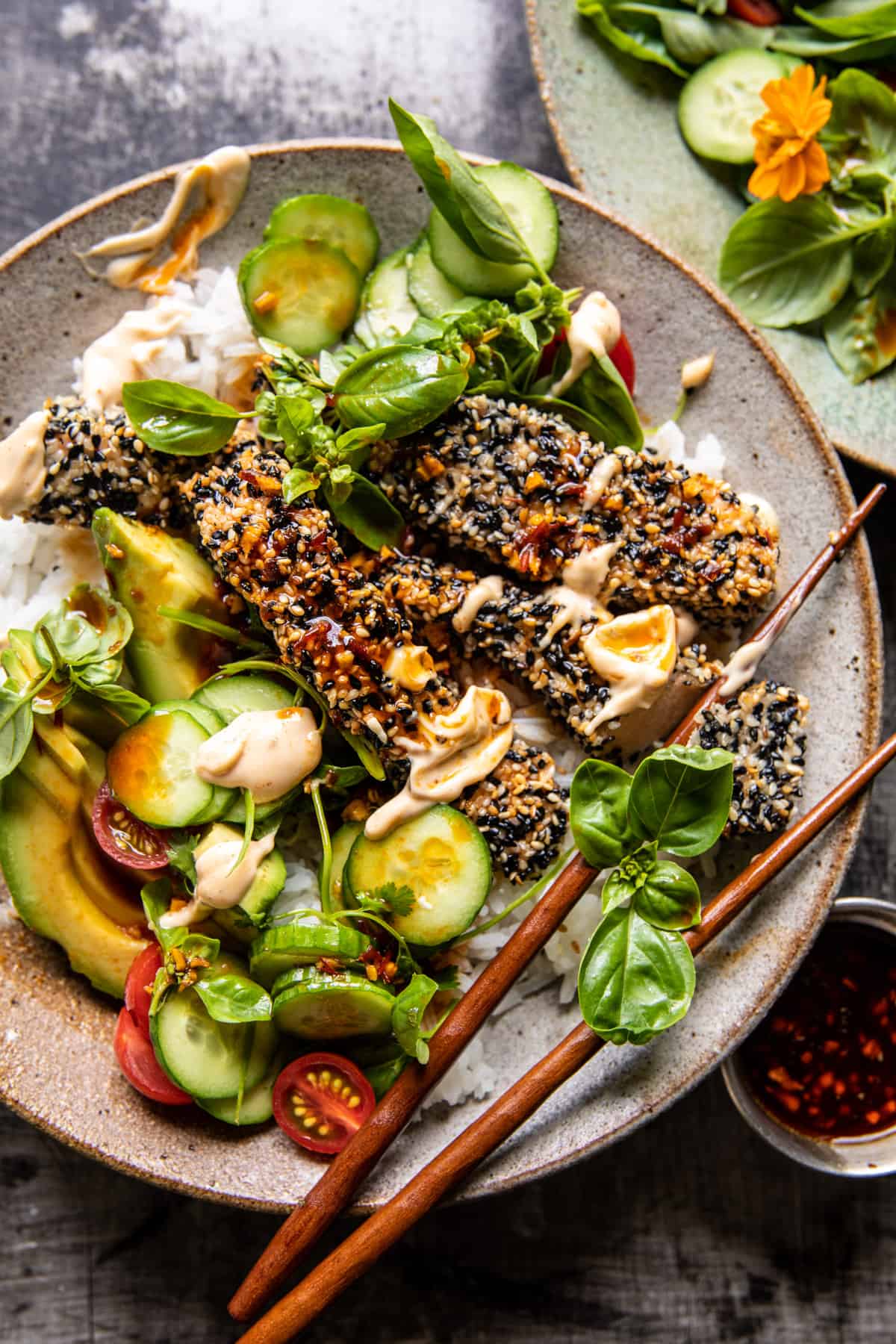
2. Place the sesame seeds in a shallow bowl. Add the egg white to a separate bowl. Toss each piece of salmon through the egg, then coat in seeds. Place on the prepared baking sheet in a single layer.
3. Drizzle the salmon with olive oil. Bake 10-15 minutes or until the salmon is cooked to your liking.
4. In a small bowl, whisk together the tamari, honey, chili sauce, toasted sesame oil, and ginger. Set the sauce aside for serving.
5. To make the salad. Combine all ingredients in a bowl. Season with salt.
6. For the spicy mayo, combine all ingredients in a bowl.
7. Spoon the salmon over the bowls of rice. Top with the herb salad and drizzle the soy ginger sauce over everything. Add a dollop of spicy mayo. Enjoy!
1. In a bowl, combine the tamari, fish sauce, honey, ginger, and chili paste.
2. Melt the butter in a large skillet over medium-high heat. Add the salmon, skin side down and cook for 3 minutes, until the salmon is crisp. Flip, reduce the heat to medium and add the garlic. Cook another minute.
3. Pour in the sauce. Cook another 3 minute, until the sauce thickens. Remove the salmon from the skillet.
4. To the skillet add 1/4 cup water. Scrape up any sauce in the pan and simmer until the sauce comes back together.
5. Meanwhile, make the salsa. Combine all ingredients in a bowl. Season with salt.
6. Spoon the salmon over the bowls of rice. Pour the sauce over the salmon. Top with the salsa and enjoy! I always add extra jalapeños.
Coconut Rice
1. Combine the 1 (14 ounce) can coconut milk and 1/2 cup water in a medium pot. Bring to a low boil. Add 1 cup jasmine rice and a pinch of salt. Stir to combine, cover, then turn the heat down to the lowest setting possible. Allow the rice to cook for 10 minutes on low, then turn the heat off completely. Let the rice sit, covered, for another 15-20 minutes (don’t take any peeks inside!).
2. Remove the lid and fluff the rice with a fork.
Candied Jalapeños
1. Bring 1/3 cup honey to a gentle boil. Simmer over low for 3-5 minutes.
2. Meanwhile, arrange 2-3 sliced jalapeños in a glass jar. Pour the honey over the jalapeños. Add 2 tablespoons apple cider vinegar and a pinch of salt. Let cool. Keep stored in the fridge for up to 2 weeks.
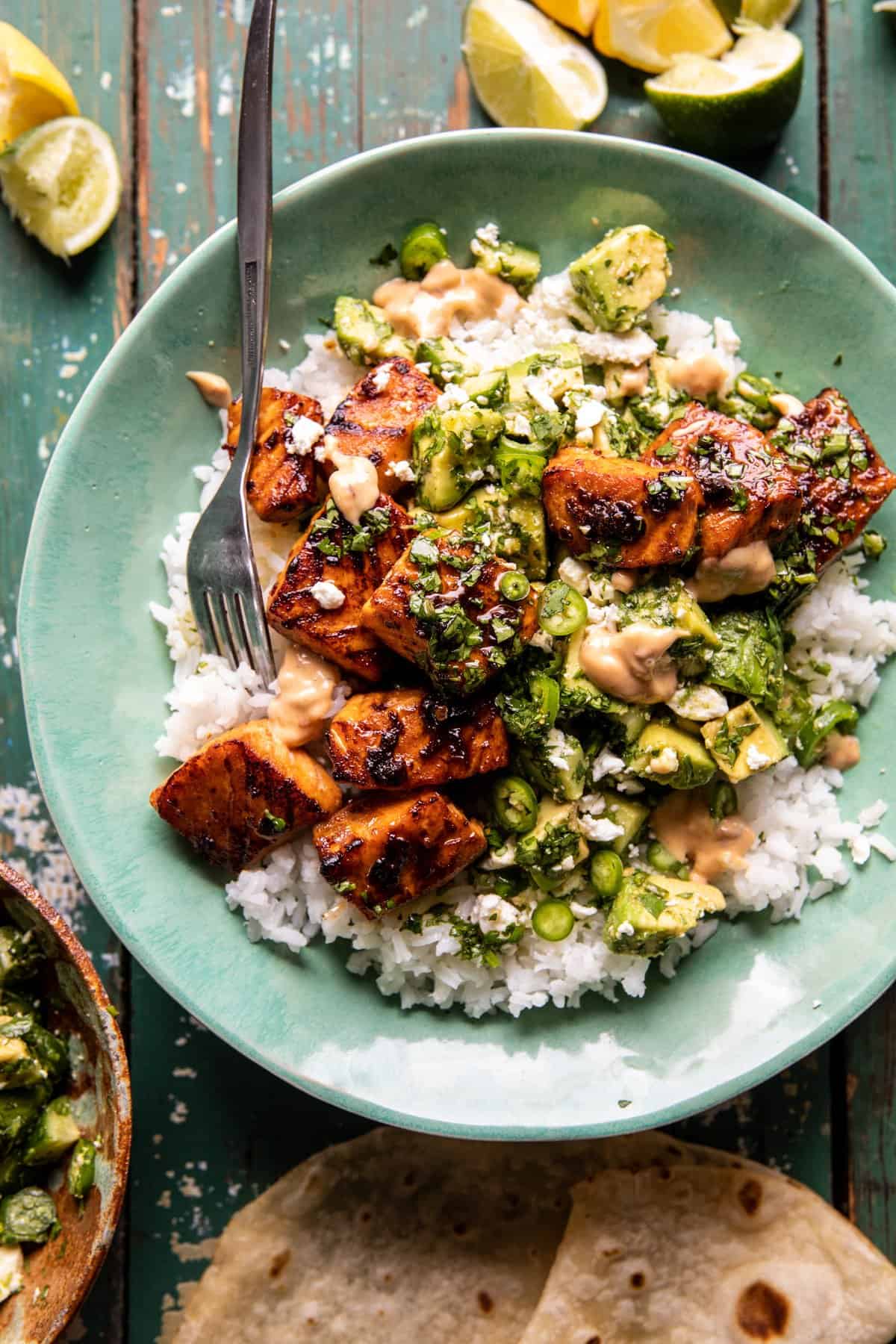
1. Preheat the oven to 450° F.
2. On a baking sheet, toss the salmon pieces with 3 tablespoons olive oil, chipotle in adobo, 2 tablespoons honey, tamari (or soy sauce), and a pinch each of salt and pepper. Arrange in a single layer. Roast 10-15 minutes or until the salmon is cooked to your liking. During the last minute, switch the oven to broil and broil until lightly charred. Set the salmon aside.
3. In a small bowl, whisk together 3 tablespoons olive oil, 2 teaspoons honey, and the apple cider vinegar. Stir in the cilantro and season with salt and pepper. Set the sauce aside for serving.
4. To make the salad. Combine the avocado, cucumbers, serrano pepper, cilantro, cumin, and feta in a bowl. Toss with the olive oil, lime, lemon juice, and season with salt.
5. For the mayo, combine all ingredients in a bowl.
6. Spoon the salmon over the bowls of rice. Top with the avocado salad and drizzle the cilantro lime sauce over everyting. Add a dollop of spicy mayo. Enjoy!
Dissolve the brown sugar in the soy sauce in a small bowl. Set aside.
Heat the olive oil in a large saute pan or wok on medium-high heat. Add the diced red onion and bell pepper and saute until lightly browned, about 5 minutes.
Lower the heat to medium, and stir in the garlic and grated ginger. Cook for a minute more.
:max_bytes(150000):strip_icc():format(webp)/__opt__aboutcom__coeus__resources__content_migration__simply_recipes__uploads__2015__05__salmon-fried-rice-method-600-1-4f0eb4ce053d4d408bca09100e19da1a.jpg)
Add the beaten eggs and stir until just cooked. Add the cooked rice, and increase the heat to medium-high. Cook for a couple minutes more, stirring often.
:max_bytes(150000):strip_icc():format(webp)/__opt__aboutcom__coeus__resources__content_migration__simply_recipes__uploads__2015__05__salmon-fried-rice-method-600-3-ed2fe98d3567460a9d21c5d771d78413.jpg)
Add the peas, salmon, and green onions. (Be gentle with the salmon so you don't break it up too much.) Stir in the soy sauce mixture and remove from heat.
Serve immediately, garnished with cilantro.
Did you love the recipe? Give us some stars and leave a comment below!
:max_bytes(150000):strip_icc():format(webp)/__opt__aboutcom__coeus__resources__content_migration__simply_recipes__uploads__2015__05__salmon-fried-rice-method-600-5-ff323952a0134b52bb0075944425eeda.jpg)
1. Preheat the oven to 450° F. Rub a sheet pan with oil.
2. On the sheet pan, mix the salmon, 1/2 teaspoon ginger, the chipotle powder, and chile flakes. Add 2 tablespoons of olive oil, tossing to coat. Arrange the salmon to one side of the sheet pan. Add the broccoli/asparagus to the other side. Toss with olive oil, salt, and pepper. Bake for 10-15 minutes until the salmon is cooked to your liking.
3. To make the sauce. In a bowl or glass jar, combine all ingredients.
4. For the spicy creamy sauce, combine all ingredients.
5. Remove the vegetables from the sheet pan. Then, pour the honey garlic sauce over the salmon and toss it up in the sauce. Bake for another 5 minutes until the sauce is baked onto the salmon.
5. Serve the salmon, vegetables, and honey garlic sauce with avocado wedges, green onions, and toasted sesame seeds. I love this over coconut rice.
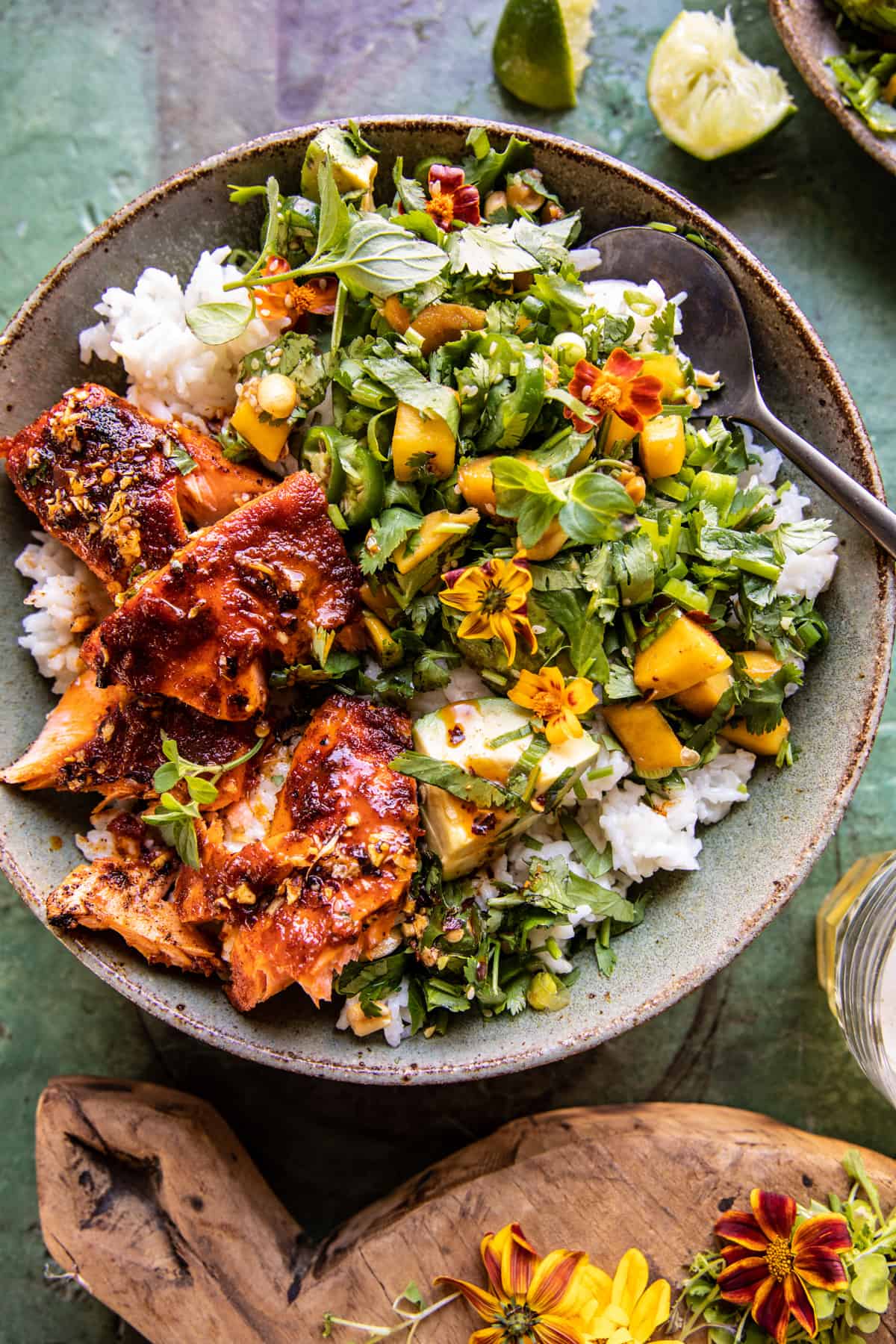
1. To make the salsa. Gently toss all ingredients in a bowl. Season with salt.
2. Preheat the oven to 450° F. Place the salmon on a baking sheet.
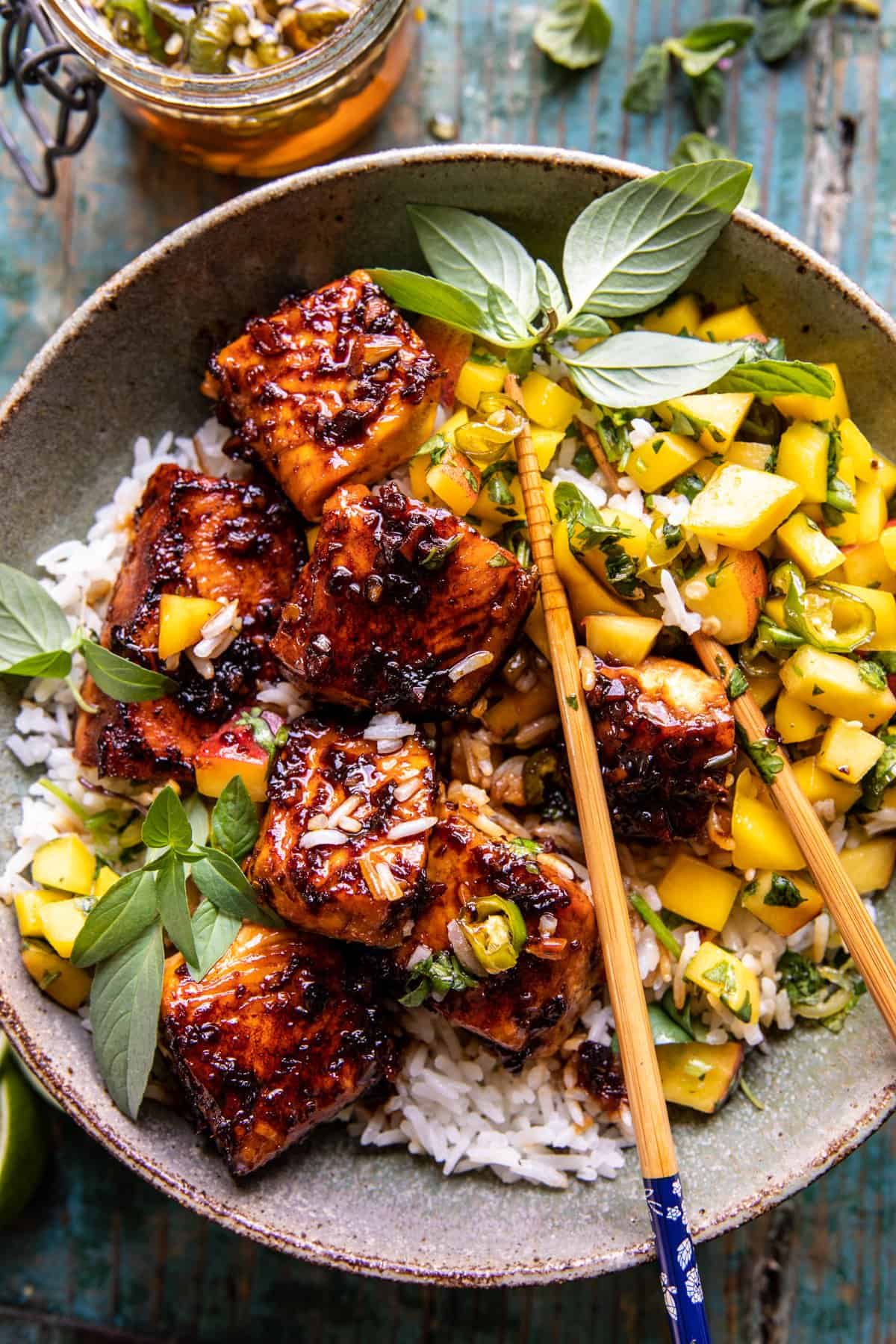
3. In a bowl, mix the olive oil, red curry paste, brown sugar, curry powder, and fish sauce. Rub the paste all over the salmon. Roast 10 minutes or until the fish is cooked to your liking. Switch the oven to broil and broil until lightly charred (watch closely!).
4. Meanwhile, in a small skillet melt together the butter, garlic, and a pinch of chili flakes. Cook until the butter is browning and the garlic is crisp. Mix in the onion flakes.
5. Break the salmon over the bowls of rice. Pour the chili butter over the salmon. Top with the mango salad. Enjoy!
1. Preheat the oven to 500° F or high broil.
2. On a baking sheet, toss the salmon with olive oil, paprika, chili powder, chipotle chili powder, garlic powder, onion powder, and a pinch of salt. If desired, thread the salmon onto skewers. Arrange in a single layer. Broil until the salmon begins to crisp, 5-8 minutes, watch closely.
3. In a large skillet over medium heat, melt together the butter, garlic, and curry paste. Cook for 2-3 minutes until very fragrant. Add the coconut milk and tamari. Mix in a handful of chopped cilantro and or basil.
4. To make the salsa, combine all ingredients in a bowl.
5. Serve the salmon and curry sauce over bowls of rice. Top with salsa.
1. Preheat oven to 450°F.
2. On a baking sheet, toss the potatoes with 2 tablespoons melted butter. Season with salt and pepper. Roast for 15 minutes, or until tender.
3. Meanwhile, whisk together both mustards, the lemon juice, shallot, cayenne, thyme, salt, pepper, and 4 tablespoons melted butter.
4. Grab the potatoes from the oven. Toss with panko, sesame seeds, and garlic. Add the salmon to the baking sheet, then pour 1/2 of the dijon dressing over the salmon. Bake for 10 minutes, or until the salmon reaches your desired doneness. During the last minute, switch the oven to broil and broil until lightly charred. Watch closely.
5. In a bowl, toss the arugula/shaved asparagus and dill with 1-2 tablespoons of the dijon dressing. Season with salt and pepper.
6. Spoon the remaining dressing over the salmon. Serve the salmon and potatoes topped with greens. Enjoy!
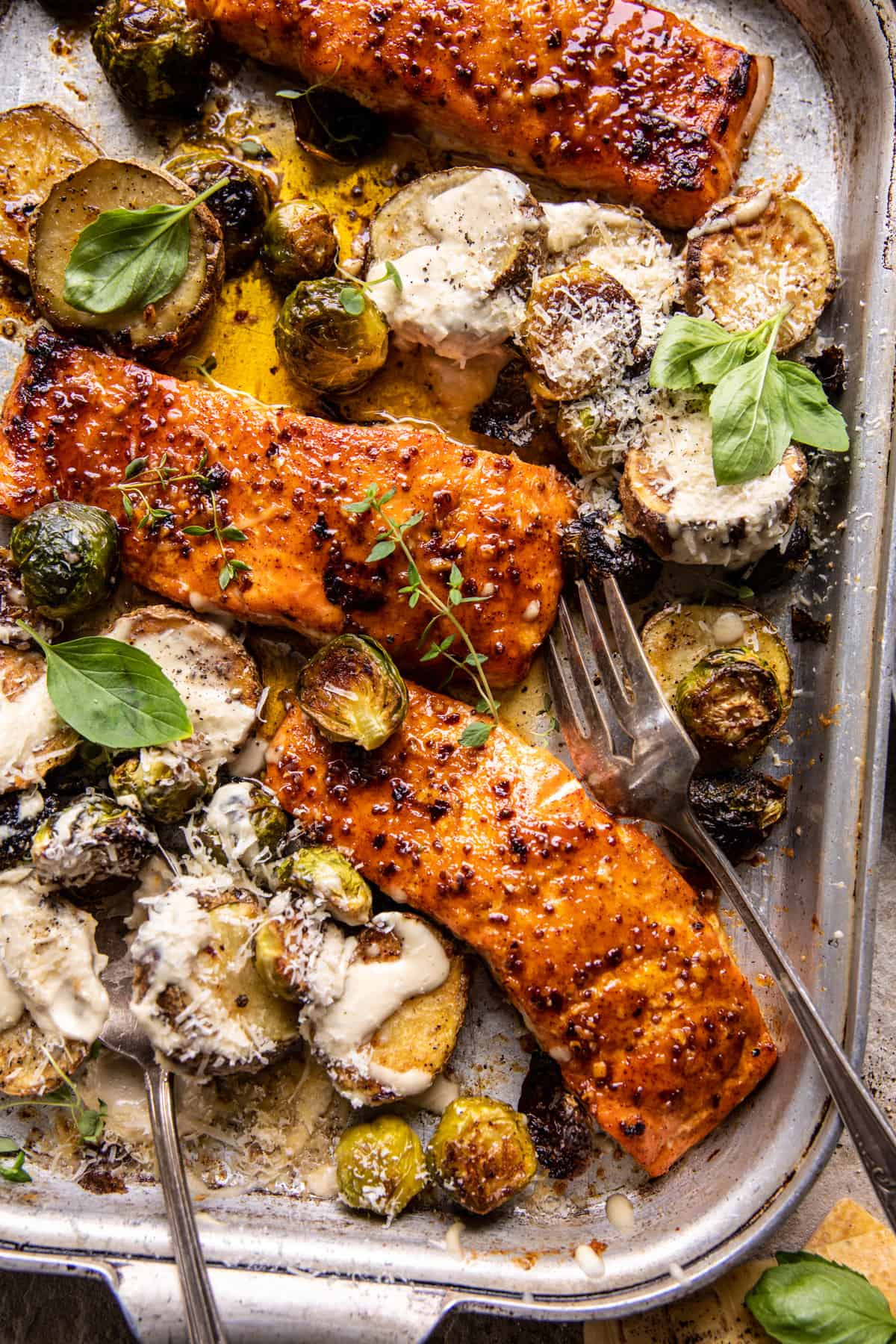
1. Preheat oven to 450° F. On a baking sheet, toss the potatoes and brussels sprouts with 2 tablespoons olive oil. Season with salt and pepper. Roast for 15 minutes, or until tender.
2. Meanwhile, whisk together the honey, mustard, garlic, chili powder, cayenne, and 2 tablespoons olive oil. Season with salt. Place the salmon on a plate and spoon the sauce evenly overtop.
3. Remove the vegetables from the oven. Add the salmon to the baking sheet. Add the butter to each filet. Bake for 10 minutes, or until the salmon reaches your desired doneness. During the last minute, switch the oven to broil and broil until lightly charred. Watch close.
4. To make the dressing. Combine all ingredients in a blender and blend until smooth. Add 1/4 to 1/2 cup water to thin the dressing. Taste and adjust the salt.
5. As soon as you pull everything out, drench the vegetables in dressing, then top with extra parmesan. Serve the salmon and any sauce left on the pan over the potatoes. Add more dressing. Enjoy!
Pull out 4 freezer bag, and label each bag with the recipe and the basic cooking instructions (you'll thank me for this later when you're trying to remember which recipe to follow!). Flip the zip-top edge of the bag outward, forming a cuff around the bag. This helps the bag stay open and upright.
Fill a large bowl or stock pot with 4 or 5 inches of water. Lay out a kitchen towel.
:max_bytes(150000):strip_icc():format(webp)/__opt__aboutcom__coeus__resources__content_migration__simply_recipes__uploads__2017__09__2017-09-29-SousVideTeriyakiSalmon-METHOD-2-800bcae3033a4d86b0302e7745e52ea7.jpg)
Whisk together the soy sauce, water, brown sugar, and vinegar for the marinade.
:max_bytes(150000):strip_icc():format(webp)/__opt__aboutcom__coeus__resources__content_migration__simply_recipes__uploads__2017__09__2017-09-29-SousVideTeriyakiSalmon-METHOD-1-53575c04636c4c40b1895570d1030720.jpg)
Aim for equal portions, though it's fine if they are different shapes. If you're buying at fish counter, you can also ask the person at the counter to do this for you.
:max_bytes(150000):strip_icc():format(webp)/__opt__aboutcom__coeus__resources__content_migration__simply_recipes__uploads__2017__09__2017-09-29-SousVideTeriyakiSalmon-METHOD-3-2132fd1fd6ec45e1a134f0deb100b036.jpg)
Divide the garlic and ginger between the fillets (about 1 teaspoon of each per fillet). Use your fingers to spread the garlic and ginger evenly over the surface of the salmon. This step helps them stick to the surface of the salmon after the teriyaki marinade is added.
:max_bytes(150000):strip_icc():format(webp)/__opt__aboutcom__coeus__resources__content_migration__simply_recipes__uploads__2017__09__2017-09-29-SousVideTeriyakiSalmon-METHOD-4-5d1f27502a504ee4aa8c9bc376935717.jpg)
Slide one fillet into each bag. Usually the fillets fit in the bottom of the bag (as pictures), but it's fine if they are sideways.
:max_bytes(150000):strip_icc():format(webp)/__opt__aboutcom__coeus__resources__content_migration__simply_recipes__uploads__2017__09__2017-09-29-SousVideTeriyakiSalmon-METHOD-5-5f2dd6978bc64d40a2a5c04890c45f55.jpg)
Holding the bag upright, add about 3 tablespoons of marinade to the bag. Flip the cuff back up and seal the bag almost closed, leaving about an inch un-zipped.
Holding the bag by the unzipped portion, submerge the bag in the pot of water. Use your other hand to gently press out any air pockets from around the salmon. Lower the bag right up to the unzipped portion so that all the air bubbles are forced out, then pinch the bag closed.
Lift the bag out of the water; the plastic should hug the sides of the salmon, pressing right up against the fish. If it doesn't, or if you see any big air bubbles around the salmon, repeat sealing the bag. (Read more here.)
Transfer the bag to the kitchen towel and pat dry. Repeat with adding the marinade and sealing the remaining freezer bags of salmon.
:max_bytes(150000):strip_icc():format(webp)/__opt__aboutcom__coeus__resources__content_migration__simply_recipes__uploads__2017__09__2017-09-29-SousVideTeriyakiSalmon-METHOD-6-552cf56644134cbb83eb911f0dc1cf79.jpg)
If desired, skip to the next step and cook the salmon right away. Otherwise, freeze the salmon overnight or up to 3 months. The marinade will become opaque but may not completely solidify; this is normal. Even if you plan on eating the salmon within a few days, I'd recommend freezing it so that the fish doesn't over-marinate.
:max_bytes(150000):strip_icc():format(webp)/__opt__aboutcom__coeus__resources__content_migration__simply_recipes__uploads__2017__09__2017-09-29-SousVideTeriaykiSalmon-5-b211f92062e24d0ea5cff6caa74cd9f2.jpg)
Fill a large pot with at least 6 inches of water. Add the Joule (or other sous vide device) and heat the water to 122°F for silky, very tender salmon, or to 130°F if you prefer your salmon more firm and flaky.
:max_bytes(150000):strip_icc():format(webp)/__opt__aboutcom__coeus__resources__content_migration__simply_recipes__uploads__2017__09__2017-09-29-SousVideTeriaykiSalmon-1-e49a853266124f699f641abc98c17123.jpg)
Once the sous vide bath is heated, add as many salmon fillets as you'd like to cook. (Do not thaw frozen salmon.) It's fine if the tops of the bags poke out from the surface of the water, but the salmon itself should be completely submerged. Add additional water if needed to cover.
Cook fresh (unfrozen) salmon for about 40 minutes, or cook frozen salmon for 70 minutes (the cooking time is the same whether cooking at 122°F or at 130°F). Salmon can be left in the sous vide bath for up to 30 minutes after the end of cooking without significant change in flavor or texture (after 30 minutes, it starts to get a little mushy).
When done, pull all the bags from the water and lay them on a kitchen towel. Pat the bags dry.
:max_bytes(150000):strip_icc():format(webp)/__opt__aboutcom__coeus__resources__content_migration__simply_recipes__uploads__2017__09__2017-09-29-SousVideTeriaykiSalmon-7-437a90e78c4f45d0959226db97db699a.jpg)
Holding the bag over a microwave-safe measuring cup, snip one of the corners of the bag and empty the teriyaki marinade into the cup. Add water as needed so that you have 1/4 cup of liquid for every salmon fillet you have prepared. Whisk in 1/2 teaspoon of cornstarch for every 1/4 cup of liquid.
Microwave on high in 30 second bursts, whisking between each burst, until the sauce thickens and bubbles around the edges (about 30 seconds for each quarter cup). If it doesn't seem to be thickening, whisk in another 1/4 teaspoon of cornstarch for each 1/4 cup and continue heating.
:max_bytes(150000):strip_icc():format(webp)/__opt__aboutcom__coeus__resources__content_migration__simply_recipes__uploads__2017__09__2017-09-29-SousVideTeriaykiSalmon-11-216df226843740e4a7d55ad74d293ff0.jpg)
While the sauce is heating, slide each salmon fillet out of its bag and onto a plate. If you'd like crispy skin (optional), warm a tablespoon of oil in a large skillet over medium-high heat and sear the salmon, skin-side down, for a few minutes or until the skin is browned and crispy.
Transfer each fillet to a plate, drizzle each one with sauce, and sprinkle with sliced green onions or chopped cilantro. Serve warm.
:max_bytes(150000):strip_icc():format(webp)/__opt__aboutcom__coeus__resources__content_migration__simply_recipes__uploads__2017__09__2017-09-29-SousVideTeriaykiSalmon-15-2aaac9e6bc7047988f840d59e4979d85.jpg)
1. Preheat the oven to 450° F. Rub a sheet pan with oil.
2. On the sheet pan, add the salmon strips/chunks, onion powder, garlic powder, paprika, and parmesan (or flour). Gently toss the salmon to coat. Add oil or butter. Bake for 10-15 minutes until the salmon is crispy on top.
3. Just before the salmon is done cooking, make the sauce. In a sauce pot, warm together all ingredients. Do not boil.
4. Drizzle the warm sauce over the salmon or serve the sauce on the side to drizzle. If the sauce thickens, gently warm it on the stove. Sprinkle with sea salt/herbs. Enjoy!
In a large bowl, gently mix together the salmon (including 2 tablespoons of the can liquid), bread, green onion, garlic, dill, bell pepper, flour, egg, paprika, lemon zest, lemon juice, salt and pepper.
:max_bytes(150000):strip_icc():format(webp)/Simply-Recipes-Salmon-Patties-METHOD-0-57157dbe7fd543b6b7c5cc69acb008e0.jpg)
Form 8 patties, about 1/2 inch thick.
:max_bytes(150000):strip_icc():format(webp)/Simply-Recipes-Salmon-Patties-METHOD-1-479ee0256ba4427bb644f6a9346aa83a.jpg)
Cover the patties and chill in the refrigerator for at least 30 minutes (or up to several hours) to help them firm up.
Heat olive oil over medium high heat in a large skillet. Cook the patties until nicely browned on both sides, about 3 to 4 minutes per side.
Did you love the recipe? Let us know with a rating and review!
:max_bytes(150000):strip_icc():format(webp)/Simply-Recipes-Salmon-Patties-METHOD-2-d6ab932356a64014b6c26028153959c2.jpg)
Position a rack in the center, line a sheet pan with foil, and set it aside.
Simply Recipes / Ciara Kehoe
:max_bytes(150000):strip_icc():format(webp)/SImply-Recipes-Salmon-Brown-Sugar-Glaze-METHOD-1-7f7a2842fe284d67a58fd3b30fce50d0.jpg)
In a small bowl, stir the brown sugar, mustard, honey, salt, black pepper, and red pepper flakes until smooth and drizzly.
Simply Recipes / Ciara Kehoe
:max_bytes(150000):strip_icc():format(webp)/SImply-Recipes-Salmon-Brown-Sugar-Glaze-METHOD-2-ead4228a726144a7bcc81b275d33429f.jpg)
If you like to eat the salmon skin, pat it very, very dry with a clean dish towel or paper towel. Skip this step if you prefer not to eat the skin.
Place the filets, skin side-down and with space between each filet, on the prepared sheet pan.
Spoon the glaze onto the filets, making sure it fully covers the tops. Use the back of the spoon to spread it out.
Simply Recipes / Ciara Kehoe
:max_bytes(150000):strip_icc():format(webp)/SImply-Recipes-Salmon-Brown-Sugar-Glaze-METHOD-3-5cf5d0d4ba294ac4854cd1dd04de5a7c.jpg)
Bake until the tops are golden brown and crispy in spots. The salmon will feel slightly firm when pressed with your fingers and it should flake easily with a fork, 12 to 14 minutes. If your filets are thin (less than an inch thick), start checking for doneness at the 10-minute mark. A digital thermometer inserted into the thickest part of the salmon should register between 125°F and 130°F—this is considered cooked medium.
Use a spatula to transfer the salmon onto plates and serve warm.
Store leftovers in the fridge for up to 4 days. To reheat, place it on a foil-lined sheet pan and bake it slowly at 300°F until warmed through. This low and slow method will prevent the salmon from drying out too much.
Did you love the recipe? Give us some stars and leave a comment below!
Simply Recipes / Ciara Kehoe
:max_bytes(150000):strip_icc():format(webp)/SImply-Recipes-Salmon-Brown-Sugar-Glaze-METHOD-4-2efa8d86164546bcbb730ba758021c9c.jpg)
Lay down a square of parchment paper on a flat surface. Fold the parchment in half to create a crease, then open it up again.
Place several slices of fennel bulb below the crease of the parchment paper in a mound, and sprinkle with salt.
Place one fillet of salmon on top of the fennel bulb slices. Squeeze fresh lemon juice over the salmon (anywhere from a teaspoon to a tablespoon, or to taste). Sprinkle the salmon generously with salt and pepper.
Lay sprigs of fennel fronds over the salmon. Lay 3 thin slices of lemon over the fennel fronds and salmon (more if you want). Or you could put the lemon sliced down first and top with the fronds, your choice. I think the slices on top look better. Dot the top with butter.
:max_bytes(150000):strip_icc():format(webp)/__opt__aboutcom__coeus__resources__content_migration__simply_recipes__uploads__2013__01__15173516__salmon-fennel-parchment-method-1-37109ab7cba9496fbb74213abfe07f80.jpg)
There are several way that you can accomplish this.
One easy and particularly attractive way is to fold a corner near the folded edge of the parchment paper into a triangle. Then about halfway down that triangle, fold another triangle over the previous triangle.
Working down and around the parchment edges, you can create folds all around the edges. When you come to the last folded edge, tuck the corner under the parchment.
There is an excellent video available that shows this technique here: How to Wrap Fish in Parchment. This technique works well with individual portions.
You may find it easier to wrap a large (multi serving) fillet in the following way. Arrange the fillet so that its long side is facing you, and the two shorter ends are to the left and right. Then lift up the parchment edges closest to you, and furthest from you, bring them together, and fold them over a few times. Then tuck the left and right edges under the fillet.
:max_bytes(150000):strip_icc():format(webp)/__opt__aboutcom__coeus__resources__content_migration__simply_recipes__uploads__2013__01__15181634__salmon-fennel-parchment-method-3-0e277953c7dd4022bedbfbdc8ce22128.jpg)
Place on a roasting pan or baking sheet. Bake at 350°F for 20 minutes.
Serve immediately. To serve, you can either carefully transfer each salmon fillet and mound of fennel slices to individual plates, or you can serve the salmon in the pouch itself, on a plate.
To eat, you can either unwrap the pouch, or cut through the top with a sharp knife to expose the salmon inside.
Set the oven to its lowest setting (mine is 150°F) to keep the salmon warm once it's cooked.
Bring a large pot of salted water to boil.
Rub both sides of the fillets with 1 teaspoon of the kosher salt and a 1/2 teaspoon of the black pepper.
:max_bytes(150000):strip_icc():format(webp)/__opt__aboutcom__coeus__resources__content_migration__simply_recipes__uploads__2018__08__Pasta-with-Salmon-METHOD-4-c6c4cf477e1f4929a07024ee3943121f.jpg)
Heat 1 tablespoon of the olive oil over medium-high heat in a large sauté pan (preferably nonstick). Once the oil starts to ripple in the pan, place the salmon fillets into the pan, skin-side up.
Press the fillets down gently to make sure the entire surface makes contact with the pan. Sear the salmon fillets for 3 minutes, or until the flesh turns an opaque pink 1/4 of the way up the sides of the fillets.
Use a spatula to flip the salmon and sear it, skin-side down, for an additional 3 minutes.
Transfer the fillets to a sheet pan and place them in the heated oven while you finish the dish. It’s okay if the salmon is not cooked completely through just yet—it will continue to cook in the oven.
:max_bytes(150000):strip_icc():format(webp)/__opt__aboutcom__coeus__resources__content_migration__simply_recipes__uploads__2018__08__Pasta-with-Salmon-METHOD-8-0092af6eab044e25a65aefb7f2abc32b.jpg)
In the same pan you used to sear the salmon, heat the remaining tablespoon of olive oil and 2 tablespoons of the butter over medium-high heat. Add the shallot and the garlic to the pan and sauté for 3 minutes, or until glossy and fragrant.
Pour the white wine and lemon juice into the pan and use a wooden spoon to scrape up any bits of food that have stuck to the bottom of the pan. Add the lemon halves and bring the mixture to a boil.
:max_bytes(150000):strip_icc():format(webp)/__opt__aboutcom__coeus__resources__content_migration__simply_recipes__uploads__2018__08__Pasta-with-Salmon-METHOD-9-fb60c0a69a4d49c6847abc7b1554fe0b.jpg)
Reduce the sauce in the pan by half by maintaining a boil. This should take 3 to 4 minutes.
By now, your pasta water should be at a rolling boil. Add generous tablespoon of salt to the boiling water and drop the pasta into the middle of the pot. Stir the pasta immediately to separate the noodles.
Lower the temperature slightly to prevent the water from boiling over and cook the pasta for 4 to 5 minutes, until al dente (or according to package directions). Drain the pasta.
Once the liquid in the pan has reduced by half, reduce the heat to medium-low. Remove the lemon halves. Slowly stir in the heavy cream and the remaining butter.
Allow the sauce to come to a simmer, then add the arugula. Stir to coat the arugula in the sauce and allow it to wilt slightly—this should only take a minute or so. Add the Parmesan, along with the remaining salt and pepper. Taste and adjust the seasoning, if necessary, by adding a bit more salt or pepper.
:max_bytes(150000):strip_icc():format(webp)/__opt__aboutcom__coeus__resources__content_migration__simply_recipes__uploads__2018__08__Pasta-with-Salmon-METHOD-12-0badc22ee2e648ab8747b165e43b4015.jpg)
Add the pasta to the pan with the sauce. Using tongs, toss in the pasta in the sauce until it is evenly coated.
:max_bytes(150000):strip_icc():format(webp)/__opt__aboutcom__coeus__resources__content_migration__simply_recipes__uploads__2018__08__Pasta-with-Salmon-METHOD-15-49375b800ed7449da5d2529a64f00232.jpg)
Remove the warm salmon fillets from the oven and arrange on top of the pasta. Serve immediately. While this dish is best enjoyed the same day it’s made, we have had success with reheating the leftovers in the microwave the next day.
:max_bytes(150000):strip_icc():format(webp)/__opt__aboutcom__coeus__resources__content_migration__simply_recipes__uploads__2018__08__Pasta-with-Salmon-METHOD-17-86c9028efbea46f59617b2bb581b51fe.jpg)
Mix all of the rub ingredients together in a medium bowl.
:max_bytes(150000):strip_icc():format(webp)/__opt__aboutcom__coeus__resources__content_migration__simply_recipes__uploads__2020__03__Jerk-Salmon-METHOD-1-6bb06119b86642d2a7954fcd28f42ca2.jpg)
Position an oven rack so it’s as close to the broiler as possible (3 inches away from the heating element is good). Line a baking sheet with foil.
Smear the rub evenly on the tops and sides of the salmon fillets. Put on the baking sheet so the filets are not touching.
:max_bytes(150000):strip_icc():format(webp)/__opt__aboutcom__coeus__resources__content_migration__simply_recipes__uploads__2020__03__Jerk-Salmon-METHOD-2-d0e830bacd0141cab9e6e501dd131cde.jpg)
Slide the sheet under the broiler. Monitor the salmon closely as it cooks. After the first 3 minutes of broiling, peek in the oven to check every minute, and lightly press the salmon with your fingertip to gauge its doneness. Broil until the salmon flakes apart when you touch it gently, 4 to 8 minutes.
Cooking time depends on the thickness of your salmon. Thinner cuts will cook more quickly than thicker cuts.
:max_bytes(150000):strip_icc():format(webp)/__opt__aboutcom__coeus__resources__content_migration__simply_recipes__uploads__2020__03__Jerk-Salmon-METHOD-5-53ed641659cf4ab28187245d9aec0586.jpg)
Rub the salmon fillets all over with 1/2 teaspoon salt. Chill for 30 minutes in the refrigerator while you prep the other ingredients.
Combine celery, red onion, capers, lemon zest and juice, dill, olive oil, black pepper in a large bowl. Set aside for the flavors to blend.
Put 4 cups water, 1 1/2 teaspoons salt, and a slice of lemon in a pot wide enough to hold the salmon. Bring to a boil and simmer for about 5 minutes. Add the salmon to the pot. Return to a simmer and cook for 4 minutes at a bare simmer.
When the salmon is just cooked through, remove it from poaching liquid and put it in a bowl. Drizzle with a teaspoon of olive oil and a teaspoon of lemon juice. Once it has cooled to touch, break the salmon gently into chunks.
Add the salmon to the bowl with the celery, onions, and capers. Gently toss to combine. Serve as is, or over mixed greens or butter lettuce.
Pat the salmon fillets dry with paper towels, then season on both sides with the salt and several grinds of black pepper.
Melt 2 tablespoons of the unsalted butter in a 10-inch nonstick skillet or well-seasoned cast iron skillet over medium heat. Add the salmon skin-side up and sear until golden brown, about 3 minutes. Flip and continue to cook until the skin is lightly crisp, about 3 minutes more.
Transfer the salmon skin-side down to a plate. It may not be cooked through, and that’s okay—it will finish cooking in the sauce.
Simply Recipes / Ciara Kehoe
:max_bytes(150000):strip_icc():format(webp)/Simply-Recipes-Salmon-Piccata-METHOD-1-1db0481140ea400a92003f2c3925b607.jpg)
Add the garlic to the pan and sautè until fragrant, less than 1 minute. Pour in the white wine and simmer, scraping up any browned bits on the bottom of the pan with a wooden spoon, until just slightly reduced, about 1 minute.
Reduce the heat to medium-low. Add the lemon zest and juice, capers, Dijon, and remaining 2 tablespoons butter. Stir to combine and melt the butter. Taste and season with salt and pepper as needed.
Simply Recipes / Ciara Kehoe
:max_bytes(150000):strip_icc():format(webp)/Simply-Recipes-Salmon-Piccata-METHOD-2-e58cb0a173584fcea92403f0536f642f.jpg)
Return the salmon skin-side down to the pan. Simmer until just cooked through and an instant-read thermometer inserted into the thickest part of the salmon registers 120°F to 130°F (for medium-rare), 1 to 2 minutes. If you like your salmon medium-well or well-done, cook for a few minutes longer. Garnish with the parsley, if desired.
This salmon piccata is best enjoyed fresh, so if you’re only serving a party of two, simply reduce the recipe by half.
Did you love the recipe? Leave us some stars below!
Simply Recipes / Ciara Kehoe
:max_bytes(150000):strip_icc():format(webp)/Simply-Recipes-Salmon-Piccata-METHOD-4-b5a94228ec56431e836db507c1f052d7.jpg)
1. Preheat the oven to 450° F.
2. On a sheet pan, add the salmon, onion powder, garlic powder, chili powder, salt, and pepper. Toss the salmon to coat. Arrange the bacon around the salmon. Bake for 10-15 minutes until the bacon is crispy and the salmon is cooked to your desired doneness.
3. To make the honey mustard. Combine all ingredients in a bowl or glass jar. Taste and adjust the salt. Toss the salmon chunks with honey mustard
4. In a skillet, melt the butter over medium heat. Add the garlic and allow the butter to brown around the garlic. Remove and mix in the jalapeño and basil or parsley.
5. Serve the salmon over bowls of lettuce, rice, and dill. Drizzle everything with garlic butter, then add additional honey mustard. Enjoy!
1. Preheat the oven to 450° F.
2. In a saucepan, combine balsamic vinegar, honey, tamari/soy sauce, garlic, thyme, oregano, and chili flakes. Set over medium heat. Bring to a boil for 3-4 minutes, until the sauce bubbles and begins to thicken. Remove from the heat.
3. On a baking sheet, toss the salmon with half of the balsamic sauce and arrange in an even layer. Arrange the asparagus around the salmon, toss with 1 tablespoon of oil and season with salt and pepper.
4. Bake for 10-15 minutes or until the salmon is cooked to your liking. During the last minute, switch the oven to broil and broil until lightly caramelized. Toss the salmon with the remaining balsamic sauce.
5. Meanwhile, combine the avocado with 1 tablespoon of oil, lemon juice, herbs, nuts/seeds, and feta in a bowl. Season with salt.
6. Spoon the asparagus and salmon over the bowls of rice. Top with lots of the avocado/feta salad mix. Enjoy!
1. In a shallow dish, mix the tamari, ginger juice, ginger, garlic, toasted sesame oil, and season with chili flakes. Add the salmon, getting them mostly submerged. Marinate for 15 minutes. For the best flavor, marinate for one hour or up to all day.
2. Make the salad. Combine all ingredients and season with salt.
3. When ready, heat a couple tablespoons of oil in a large skillet over high heat. Rub the salmon with brown sugar. Place the salmon skin side face up in the skillet. Sear until brown, about 1-2 minutes. Then flip and let the skin get crispy. Lower the heat to low. Add the marinade and simmer on low for 5-8 minutes until cooked to your liking. Then, remove from the heat.
4. Spoon the salmon over the bowls of rice. Top with the cucumber salad and a dollop of spicy mayo. Enjoy!
1. Preheat the oven to 450° F.
2. On a baking sheet, toss the salmon pieces with 3 tablespoons olive oil, paprika, salt, and pepper. Arrange in a single layer. On the other side of the pan, add the asparagus. Toss with 1 tablespoon olive oil, salt, and pepper. Roast 10-15 minutes or until the salmon is just undercooked to your liking.
3. Meanwhile, make the hot honey. In a sauce pot, warm together the honey, hot sauce, cayenne, chili powder, onion powder, and garlic powder, plus a pinch of salt.
4. Spoon some of the hot honey over the salmon. Switch the oven to broil and broil until lightly charred and crispy. Spoon over additional hot honey, to your taste.
5. To make the salsa. Combine all ingredients in a bowl and season with salt, gently tossing.
6. Arrange the salmon and asparagus over bowls of rice. Top with salsa. Add ranch on the side or drizzle over each bowl. Enjoy!
Combine mangoes, avocado, orange bell pepper, and jalapeno in a large bowl to make salsa. Add lime juice, cilantro, and salt; mix to combine. Cover with plastic wrap and refrigerate.
Sprinkle seafood rub, chili powder, salt, and black pepper over 1 side of each salmon steak; rub in with your fingers until evenly distributed.
Coat the bottom of a large skillet with olive oil and heat over medium-high heat. Add salmon skin-side down and cook until skin is crisp, 4 to 5 minutes. Flip salmon and carefully peel off skin. Season top with seafood rub, chili powder, salt and black pepper. Continue cooking until lightly browned on the second side and salmon flakes easily with a fork, 4 to 5 minutes.
Slice each salmon fillet lengthwise to create 6 pieces.
Lightly oil another skillet over medium heat. Pan-fry corn tortillas, one at a time, until heated through and pliable, about 30 seconds per side.
Place 1 piece of salmon on each tortilla. Top with salsa. Squeeze a wedge of lime on top.
:max_bytes(150000):strip_icc():format(webp)/4539795-a4dccc6bbb5049ea9c1a7725df8d1a08.jpg)
Place salmon fillets on a baking sheet; season with salt and black pepper.
Combine pecans, maple syrup, vinegar, paprika, chipotle powder, and onion powder in a food processor; pulse until crumbly. Spoon pecan mixture on each salmon fillet, coating entire top surface. Refrigerate coated salmon, uncovered, for 2 to 3 hours.
Preheat the oven to 425 degrees F (220 degrees C).
Bake in the preheated oven until salmon flakes easily with a fork, 12 to 14 minutes.
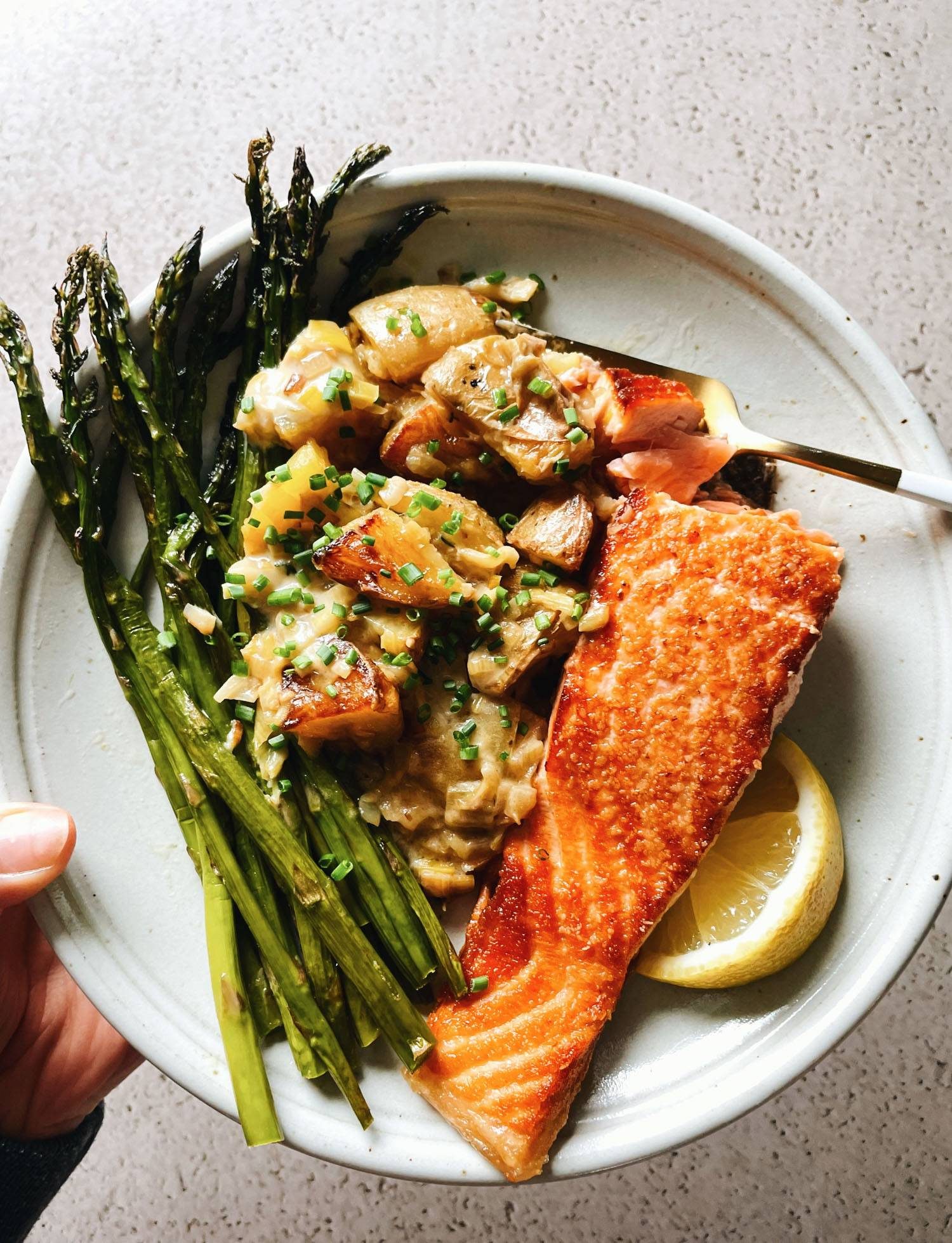
Preheat the oven to 425 degrees. Place the sliced leeks in a bowl of water. Gently massage and break them apart so that any dirt trapped between the layers gets released. Let the dirt settle and then pull the leeks out of the bowl, discarding the water. Repeat as many times as necessary to get them clean. (My 3 year old daughter loves to help with this! Great kid activity.)
Place your potatoes on a sheet pan and drizzle with olive oil. Season with salt and pepper. Roast for 10 minutes.
After ten minutes, add the asparagus to the pan, drizzle with olive oil and season with salt and pepper. Return the pan to the oven for another 10-15 minutes.
While everything is roasting, melt the butter in a skillet over medium high heat. Add the leeks; cook for 10 minutes, stirring occasionally, until the leeks are soft and yummy.
Add the garlic and thyme in with the leeks; cook for a few minutes until it’s very fragrant. Add the broth and the cream; let the whole thing come to a low simmer until it’s comes together like a nice creamy sauce, about 10-15 minutes (I just leave it on the heat slowly bubbling while the other veggies are roasting). Remove from heat and add the lemon zest to the mixture. Taste and season.
Heat a bit of oil in a skillet over medium high heat. Add the salmon, skin side down, and cook for a few minutes until you can gently release and flip the salmon. Cook for a few minutes on the other side until the exterior is golden brown and the salmon is cooked to your desired level of doneness.
Pour the creamy leek mixture over the roasted potatoes. Bake for 10 minutes or until the salmon is done and the creamed leeks and potato mixture is bubbly and browned at the edges. Serve straight off the pan with lemon wedges and extra herbs. YUMO!
Mix sesame oil, lemon juice, soy sauce, brown sugar, sesame seeds, ground mustard, ginger, and garlic powder in a small saucepan over low heat. Bring to a simmer, stirring until sugar has dissolved. Set aside 1/2 cup of marinade for basting.
Pour remaining marinade into a resealable plastic bag. Add salmon steaks, coat with marinade, squeeze out excess air, and seal the bag. Marinate in the refrigerator for 1 to 2 hours.
Set an oven rack about 6 inches from the heat source and preheat the oven's broiler.
Broil salmon steaks under the preheated broiler for 5 minutes, brushing salmon with reserved marinade. Turn and continue to broil until salmon is opaque and flakes easily, about 5 more minutes. Brush with marinade.
:max_bytes(150000):strip_icc():format(webp)/228285teriyaki-salmonFranceC4x3-495e53221ca54183bf0ff5b2fa5aae55.jpg)
Prep the salmon: Remove the skin from your salmon, if it has skin. Pat with paper towels so the surface is mostly dry. Cut your salmon into cubes, 1 to 2 inches each (see photo).
Prep the spices: Mix the spices together in a small bowl.
Toss salmon with spices: Toss your salmon cubes in the spices and oil – I usually use my hands to mix it all together.
Air fry the salmon: Place your salmon pieces in the air fryer (I just dump them right in) and spread them out a bit so they’re not laying all over each other. Air fry at 400 degrees for 8 minutes!
You’re Done! Yum! At this point it should be textured and golden on the outside, and juicy and delicious on the inside. When you press each piece with a fork, they should easily flake / slip apart with a buttery, juicy texture inside. (You can do 6-7 minutes if you prefer more of a medium doneness.)
Gather all ingredients.
:max_bytes(150000):strip_icc():format(webp)/9401-salmon-patties-DDMFS-step-1-BG-31738-562e383e217745ecaa70893e1f565b51.jpg)
Drain and reserve liquid from canned salmon; place salmon in a medium bowl. Add bread crumbs, onion, and egg; mix well to combine.
:max_bytes(150000):strip_icc():format(webp)/9401-salmon-patties-DDMFS-step-3-BG-31744-dd76c4e0c426409b9c842627a1534018.jpg)
Shape mixture into patties, adding reserved liquid from salmon if the mixture is too dry.
:max_bytes(150000):strip_icc():format(webp)/9401-salmon-patties-DDMFS-step-4-BG-31749-050da986edab4aeb86bb813c66007893.jpg)
Heat oil in a large skillet over medium heat; add patties and cook until golden brown, about 3 to 4 minutes per side.
:max_bytes(150000):strip_icc():format(webp)/9401-salmon-patties-DDMFS-step-5-BG-31755-23f5184de15844d0a59061f2119a50f3.jpg)
Drain on paper towels. Serve and enjoy!
:max_bytes(150000):strip_icc():format(webp)/9401-salmon-patties-DDMFS-beauty-4x3-BG-31797-c37be26ee277482e8b278f49b697ccf5.jpg)
Gather all ingredients.
:max_bytes(150000):strip_icc():format(webp)/51283-RM-maple-salmon-ddmfs-ingredients-3x4-2545-72f70c4b27f14b0ca50ad9461db872c2.jpg)
Stir maple syrup, soy sauce, garlic, garlic salt, and pepper together in a small bowl.
:max_bytes(150000):strip_icc():format(webp)/51283-RM-maple-salmon-ddmfs-step1-3x4-2547-af591fc87a9143b7ad30e83cc79729da.jpg)
Cut salmon into 4 equal-sized fillets; place in a shallow glass baking dish and coat with maple syrup mixture. Cover the dish and marinate salmon in the refrigerator for 30 minutes, turning once halfway.
:max_bytes(150000):strip_icc():format(webp)/51283-RM-maple-salmon-ddmfs-step3-3x4-2552-ccac344c049a4586b63c9cd9e416dcca.jpg)
Preheat the oven to 400 degrees F (200 degrees C).
Place the baking dish in the preheated oven and bake salmon uncovered until flesh easily flakes with a fork, about 20 minutes.
:max_bytes(150000):strip_icc():format(webp)/51283-RM-maple-salmon-ddmfs-step5-3x4-2578-52aacfbe7fab479a8ea34ed9cc8e29c1.jpg)
Enjoy!
:max_bytes(150000):strip_icc():format(webp)/51283-RM-maple-salmon-ddmfs-3x4-2624-1e5a9dc354a54744b72c6e19e8fbbcca.jpg)
Soak rice for 4 hours. Drain rice and cook in a rice cooker with 2 cups of water. Rice must be slightly dry as vinegar will be added later.
Immediately after rice is cooked, mix in rice wine vinegar; spread rice on a plate until completely cool.
Place 1 sheet of seaweed on a bamboo mat; press a thin layer of cool rice on seaweed, leaving at least a 1/2 inch top and bottom edge of the seaweed uncovered. This is for easier sealing later. Dot some wasabi on rice; arrange smoked salmon, cucumber, and avocado on rice about 1 inch away from the bottom edge of seaweed.
Slightly wet the top edge of seaweed; roll up tightly from the bottom to the top edge with the help of the bamboo mat. Cut salmon roll into 8 equal pieces and serve. Repeat for other rolls.
Whisk soy sauce, olive oil, brown sugar, lemon pepper, and garlic together in a shallow dish; lay salmon fillets skin-side up in the marinade; marinate in the refrigerator 4 to 8 hours or overnight.
Preheat the oven's broiler and set the oven rack about 6 inches from the heat source. Transfer salmon fillets from marinade onto a baking sheet. Discard any remaining marinade.
Cook salmon under the broiler until lightly browned and the flesh flakes easily with a fork, 7 to 10 minutes. Allow salmon to rest for a few minutes before slicing and serving.
Gather all ingredients. Preheat the oven to 400 degrees F (200 degrees C). Line a baking sheet with parchment paper; set aside.
:max_bytes(150000):strip_icc():format(webp)/200296-Salmon-Wellingtons-ddmfs-4x3-step-01-2115-acd76d5cbe5d41aca98c7fbb67ad4f2a.jpg)
Pat salmon fillet dry with paper towels. Sprinkle salt and pepper on both sides of salmon fillet.
:max_bytes(150000):strip_icc():format(webp)/200296-Salmon-Wellingtons-ddmfs-4x3-step-02-2117-306f86ba7c00442686767f4ddb39c6ab.jpg)
Mix mayonnaise, mustard, oregano, basil, dill, lemon zest, and thyme in a small bowl. Set aside ½ of the mixture for serving.
:max_bytes(150000):strip_icc():format(webp)/200296-SalmonWellingtons-ddmfs-4x3-step-03-2120-68a4e0009b95488c9f4e894fedecf0fe.jpg)
Spread remaining mixture on the top of salmon fillet.
:max_bytes(150000):strip_icc():format(webp)/200296-Salmon-Wellingtons-ddmfs-4x3-step-04-2122-d3ea1b222e704fae99565afa320ab3a6.jpg)
Unfold puff pastry on a lightly floured surface. Use your fingers to even out the folds in the pastry.
:max_bytes(150000):strip_icc():format(webp)/200296-Salmon-Wellingtons-ddmfs-4x3-step-05-2123-2e865818d33e40ab98d3d0c418b61f28.jpg)
Spread spinach in center of pastry in a rectangle the size of the fillet, and sprinkle with feta cheese.
:max_bytes(150000):strip_icc():format(webp)/200296-Salmon-Wellingtons-ddmfs-4x3-step-07-2125-4983fea84f9747cebd28858efce8bb5b.jpg)
Place salmon, mayonnaise-side down, on top of feta cheese.
:max_bytes(150000):strip_icc():format(webp)/200296-Salmon-Wellingtons-ddmfs-4x3-step-08-2127-c4c0be457f30491da61ba7424ec6ca2d.jpg)
Beat egg and water together in small bowl. Brush the edges of pastry with egg wash to ensure the puff pastry is “glued” together.
:max_bytes(150000):strip_icc():format(webp)/200296-Salmon-Wellingtons-ddmfs-4x3-step-09-2129-4d70009a4fee4f23bc130fd58fa07f15.jpg)
Lift edges of pastry and slightly stretch to enclose the salmon.
:max_bytes(150000):strip_icc():format(webp)/200296-Salmon-Wellingtons-ddmfs-4x3-step-10-2130-a51bb9594c464e149c378a1229884812.jpg)
Pinch edges to seal. Place the bundle, seam-side down, on prepared baking sheet. Brush egg wash on tops and sides of pastry.
:max_bytes(150000):strip_icc():format(webp)/200296-Salmon-Wellingtons-ddmfs-4x3-step-11-2131-af2b9f503c4944cd95ba5e70f61c3db9.jpg)
Cut several small slits in top of pastry to allow steam to escape.
:max_bytes(150000):strip_icc():format(webp)/200296-Salmon-Wellingtons-ddmfs-4x3-step-12-2133-fad600f32b0048e297b5225e68f1a4da.jpg)
Bake in preheated oven until pastry is golden brown, about 40 minutes. An instant-read thermometer inserted into the center of the salmon should be at least 145 degrees F (62 degrees C). Let stand for a few minutes before serving.
:max_bytes(150000):strip_icc():format(webp)/200296-Salmon-Wellingtons-ddmfs-4x3-step-13-2145-e02124cd7a614a8e9dbed80e4e4c19b0.jpg)
Serve with reserved herb Dijon mixture and lemon wedges.
:max_bytes(150000):strip_icc():format(webp)/200296-Salmon-Wellingtons-ddmfs-4x3-step-14-2147-2f02cc502057446d895511cd2acd8443.jpg)
Season the top of the salmon fillets with salt, pepper, and a little cayenne. Spread 1/2 of the melted butter all over the surface. Sprinkle with chopped dill, and drape 2 slices of smoked salmon over each fillet, covering the surface and sides. Place prepped fish in the fridge until needed.
Preheat the oven to 400 degrees F (200 degrees C).
Spread mashed potatoes into 2 baking dishes (I used oval ramekins), and set salmon fillets on top. Sprinkle a little cayenne over the top if desired. Set baking dishes on a baking sheet for easy transfer.
Roast salmon in the preheated oven until internal temperature in the center of the thickest part of the fillet reads 135 to 140 degrees F (57 to 60 degrees C), about 20 minute.
Once roasted, brush the remaining melted butter over the top of the salmon fillets and garnish with green onions. Serve with lime wedges.
:max_bytes(150000):strip_icc():format(webp)/7370170SmokedSalmonRoastSalmonChefJohn4x3cutpiece-20c72e30ce904930a15c450d4ca1f78d.jpg)
Drain salmon, reserving 3/4 cup of the liquid. Flake the meat.
Melt butter in a large skillet over medium-high heat. Add onion and cook until tender.
Combine onion with reserved salmon liquid, 1/3 of the cracker crumbs, eggs, parsley, mustard, and salmon in a medium bowl. Mix until well blended, then shape into 6 patties. Coat patties in remaining cracker crumbs.
Melt shortening in a large skillet over medium heat. Cook patties until browned, then carefully turn and brown on the other side.
:max_bytes(150000):strip_icc():format(webp)/58868oregon-salmon-pattiessouplovingnicolevideo4x3-6dab5eae4e65450cb8f21020a71f1d95.jpg)
Melt the butter in a saucepan over medium heat, and mix in the honey, brown, sugar, and coconut. Bring to a boil, and remove from heat. Cool slightly, and transfer to a large bowl. Place the salmon in the bowl, and turn to coat. Cover, and marinate at least 30 minutes in the refrigerator.
Preheat oven to 375 degrees F (190 degrees C).
Spread enough of the marinade mixture in a baking dish to coat the bottom. Arrange the salmon in the dish, and pour some of the marinade over the top, being sure to get some of the coconut on the top.
Bake 25 minutes in the preheated oven, basting occasionally with the remaining marinade, until the salmon is flaked easily with a fork. Discard any leftover marinade, or bring to a boil, cook for 5 minutes, and spoon over salmon.
Preheat a large heavy skillet over medium heat for 3 minutes.
Coat salmon fillets with olive oil; place skin-side down in the preheated skillet and increase heat to high.
:max_bytes(150000):strip_icc():format(webp)/21736-PanSearedSalmon-ddmfs-Step1-0343-636fc708314e4fd0be6ddb24e9d44366.jpg)
Sprinkle with capers, salt, and pepper; cook for 3 minutes on one side. Turn salmon fillets over; continue to cook until salmon flakes easily with a fork, about 5 minutes.
:max_bytes(150000):strip_icc():format(webp)/21736-PanSearedSalmon-ddmfs-Step3-0345-dd93d5943bed4b3c88c6248d2981b6e5.jpg)
Transfer salmon to individual plates and garnish with lemon slices.
:max_bytes(150000):strip_icc():format(webp)/21736-PanSearedSalmon-ddmfs-Step4-0349-7f86294cb2bf420fa99f4dea30922492.jpg)
Stir together mango, lime juice, pepper jam, and cilantro in a large bowl until well combined. Cover the bowl and refrigerate for relish flavors to combine, about 30 minutes.
Season salmon fillets with sea salt.
Heat oil in a large nonstick skillet over medium-high heat until oil begins to smoke. Place salmon, flesh-side down, in the hot skillet and cook until edges start to cook through, about 2 minutes. Flip fillets, remove the skillet from heat, and let salmon sit in the hot skillet until cooked through, 2 to 3 minutes more. Transfer to a plate and top with chilled mango relish.
:max_bytes(150000):strip_icc():format(webp)/2744045-19f9dc8a426244e0b444a472bce0f2cc.jpg)
Stir salmon, eggs, lemon juice, capers, salt, black pepper, and cayenne pepper together in a bowl until well-combined.
Crush saltine crackers with your hands into the salmon mixture and mix well. Wrap the bowl with plastic wrap and refrigerate, 30 minutes to overnight.
Dust a plate with half the bread crumbs. Divide salmon mixture into 4 portions and shape into patties; place onto prepared plate and sprinkle remaining bread crumbs atop the salmon patties.
Melt butter and oil in a large skillet over medium heat. Cook patties in hot oil until cooked and heated through, about 5 minutes per side.
:max_bytes(150000):strip_icc():format(webp)/3375812-4bbc9cdb0a1c4bdbab6d444a9e177c74.jpg)
Combine black pepper, paprika, cayenne pepper, minced garlic, Dijon mustard, brown sugar, onion powder, and salt in a small bowl. Stir in 1 tablespoon olive oil to make a paste.
Spread paste over salmon fillets; set aside to marinate at room temperature for 30 minutes.
Heat remaining 2 tablespoons olive oil in a small pan over medium heat. Stir in onion; cook until tender and golden brown, about 10 minutes.
Heat a separate nonstick skillet over medium-high heat. Cook salmon fillets in the hot skillet until golden brown on each side and no longer translucent in the center, about 4 minutes per side.
Pour caramelized onions and olive oil over salmon fillets to serve.
Preheat the oven to 400 degrees F (200 degrees C).
Fold two pieces of parchment paper in half; cut a half-circle starting at each crease. You should have two heart-shaped pieces of parchment when unfolded. Coat both sides of each parchment heart with olive oil.
Place potatoes in a saucepan and cover with salted water; bring to a boil. Reduce heat to medium-low and simmer until tender, about 20 minutes. Drain.
While potatoes simmering, bring a pot of lightly salted water to a boil. Add asparagus, and cook uncovered until slightly tender, about 5 minutes. Drain in a colander, then immediately immerse in ice water for several minutes until cold to stop the cooking process. Once the asparagus is cold, drain well, and set aside.
Place 1 salmon fillet, half the asparagus, and half the potatoes in the middle of one side of one prepared parchment paper heart. Sprinkle with salt and pepper; drizzle with extra-virgin olive oil. Fold other half of paper heart over; seal parchment edge by making overlapping folds around the edge. At the end, fold the last crease in the opposite direction of the rest to ensure it seals. Repeat with the second piece of prepared parchment and remaining ingredients. Place pouches on a baking sheet.
Bake in the preheated oven for 15 minutes. Remove from oven and allow to sit for 5 minutes before cutting parchment open. The salmon is done when it flakes easily with a fork.
:max_bytes(150000):strip_icc():format(webp)/6515152-b15062434ea24a4a84e897e7c7a78742.jpg)
Gather all ingredients.
:max_bytes(150000):strip_icc():format(webp)/239541-Chef-Johns-Fresh-Salmon-Cakes-DDMFS-Step-01a-b9dd5cae02b1444aaa5913a412892990.jpg)
Heat extra virgin olive oil in a skillet over medium heat. Cook and stir onion, red pepper, celery, and a pinch of salt in hot oil until onion is soft and translucent, about 5 minutes.
:max_bytes(150000):strip_icc():format(webp)/239541-Chef-Johns-Fresh-Salmon-Cakes-DDMFS-Step-01b-2253c30227f741e49ed998ffbfbe545a.jpg)
Add capers; cook and stir until fragrant, about 2 minutes. Remove from heat and cool to room temperature.
:max_bytes(150000):strip_icc():format(webp)/239541-Chef-Johns-Fresh-Salmon-Cakes-DDMFS-Step-02-e2a7c21ce4784594a30c51507b50e64c.jpg)
Stir salmon, onion mixture, mayonnaise, 1/4 cup bread crumbs, garlic, mustard, cayenne, seafood seasoning, salt, and ground black pepper together in a bowl until well-mixed. Cover the bowl with plastic wrap and refrigerate until firmed and chilled, 1 to 2 hours.
:max_bytes(150000):strip_icc():format(webp)/239541-Chef-Johns-Fresh-Salmon-Cakes-DDMFS-Step-03-1a3e44bf14d54ceeafb79e423b5c7c07.jpg)
Form salmon mixture into four 1-inch thick patties; sprinkle remaining panko bread crumbs over each patty.
:max_bytes(150000):strip_icc():format(webp)/239541-Chef-Johns-Fresh-Salmon-Cakes-DDMFS-Step-05-edd6714bc1f04ea3aa9b511928e1fdf6.jpg)
Heat olive oil in a skillet over medium-heat. Cook patties in hot oil until golden and cooked through, 3 to 4 minutes per side.
:max_bytes(150000):strip_icc():format(webp)/239541-Chef-Johns-Fresh-Salmon-Cakes-DDMFS-Step-06-5cd88d27aa0447e299b84f15bc218bde.jpg)
Serve and enjoy!
:max_bytes(150000):strip_icc():format(webp)/239541-Chef-Johns-Fresh-Salmon-Cakes-DDMFS-4x3-e1b9020783344d21bb19efa8ffeead68.jpg)
Place salmon in a shallow, flat dish, and set aside. Combine the vinegar, olive oil, soy sauce, water, lemon juice, red pepper flakes, onion powder, garlic powder, cilantro, and brown sugar in a blender. Blend until brown sugar dissolves. Pour the marinade over the salmon to cover evenly. Cover the dish, and refrigerate at least 2 hours.
Line a broiling pan with foil. Remove salmon from marinade, and place on prepared broiling pan; season to taste with salt and pepper. Transfer remaining marinade to a saucepan.
Turn on broiler to low.
Broil salmon about 6 inches from the heat for 5 minutes; brush with remaining marinade. Broil an additional 5 to 10 minutes, brushing 2 or 3 more times with additional marinade. Salmon is done when fish is no longer bright red and can be flaked with a fork.
Meanwhile, cook the remaining marinade over low heat until it thickens and reduces by one-third, 5 to 10 minutes. Use cooked marinade as a dipping sauce or drizzle over salmon just before serving.
Preheat oven to 375 degrees F (190 degrees C).
Cut the filets into log shaped pieces, about 2 inches wide by 5 inches long, keeping the filet portions separate. Take 2 sheets of phyllo dough, placing one on top of the other, and brush lightly with melted butter, covering the one side completely.
Place a portion of salmon (6 ounces), on the edge, nearest you, of the phyllo dough. Sprinkle with salt and pepper to taste. Coat the portion of salmon with 1 tablespoon of Dijon mustard.
Fold the phyllo dough, nearest you, over the salmon and make one complete wrap. Take the sides of the dough and fold them towards the center, and continue rolling up the dough. Brush all sides with butter, covering completely and place on a cookie sheet. Repeat steps for remaining portions of salmon.
Bake in preheated oven for 20 minutes or until phyllo dough is golden brown.
Gather all ingredients.
:max_bytes(150000):strip_icc():format(webp)/AR-240130-scrumptious-salmon-cakes-DDMFS-Step-1-9a4a962922ef4ea88eff99c35169e5fe.jpg)
Mix salmon, panko, parsley, eggs, green onions, Worcestershire sauce, Parmesan cheese, Dijon mustard, creamy salad dressing, seafood seasoning, garlic powder, and pepper together in a large bowl.
:max_bytes(150000):strip_icc():format(webp)/AR-240130-scrumptious-salmon-cakes-DDMFS-Step-2-1f68070319264bd2a1d69ecd4ded0493.jpg)
Divide mixture and shape into 8 equal-sized patties.
:max_bytes(150000):strip_icc():format(webp)/AR-240130-scrumptious-salmon-cakes-DDMFS-Step-3-92a625da1c414ecf9b84293d8f9ed953.jpg)
Heat enough olive oil in a large skillet to cover the cooking surface over medium heat. Fry salmon patties in batches until browned, 5 to 7 minutes per side. Repeat with more olive oil as needed.
:max_bytes(150000):strip_icc():format(webp)/AR-240130-scrumptious-salmon-cakes-DDMFS-Step-4-0bb13b20ca22424984e0b78c0f751395.jpg)
Serve and enjoy!
:max_bytes(150000):strip_icc():format(webp)/AR-240130-scrumptious-salmon-cakes-DDMFS-4x3-d3a4c962e2eb4dba861dc00d4c66dbd2.jpg)
Preheat oven to 350 degrees F (175 degrees C). Line a baking sheet with aluminum foil; grease the foil lightly.
Place salmon fillet with skin side down on foil. Season salmon with lemon-pepper and onion salt; top with onion rings and lemon slices, dot with butter. Fold foil around salmon and seal tightly.
Bake in preheated oven for 20 minutes. Unseal the foil and turn the oven's broiler on. Continue cooking the salmon under the broiler until the flesh flakes easily with a fork, 8 to 12 minutes.
While the salmon bakes, stir sour cream, mayonnaise, white wine, capers, chopped onion, caper brine, lemon juice, horseradish, dill weed, garlic salt, and black pepper together in a bowl. Serve with the salmon.
Gather all ingredients.
:max_bytes(150000):strip_icc():format(webp)/19494-poached-salmon-ddmfs-4x3-step-01-b33ac8e4d61b47a8b285b0d7392300ed.jpg)
Heat wine and water in a large nonstick skillet over medium heat.
:max_bytes(150000):strip_icc():format(webp)/19494-poached-salmon-ddmfs-4x3-step-02-3c5dfdfa6b1f44c09e32d9c5a8b18368.jpg)
Gently slide salmon fillets into poaching liquid. Dot fillets with butter, then sprinkle parsley, garlic, salt, and pepper over top.
:max_bytes(150000):strip_icc():format(webp)/19494-poached-salmon-ddmfs-4x3-step-04-ec3cbaa6a1894589a2ae7ae8689df187.jpg)
Bring to a simmer, then reduce heat to medium-low and poach until salmon flesh is firm and flakes easily with a fork, 10 to 15 minutes.
:max_bytes(150000):strip_icc():format(webp)/19494-poached-salmon-ddmfs-4x3-step-05-3735f0ec96cc44738170babfc8310a9c.jpg)
Gather all ingredients.
:max_bytes(150000):strip_icc():format(webp)/AR-189058-super-simple-salmon-ddmfs-step-1-b5163d912bf14f928cccf44433acc77a.jpg)
Stir garlic powder, basil, and salt together in a small bowl.
:max_bytes(150000):strip_icc():format(webp)/AR-189058-super-simple-salmon-ddmfs-step-2-3c6faf482b86484aa8d5da38d5cbec1b.jpg)
Rub the mixture evenly over salmon.
:max_bytes(150000):strip_icc():format(webp)/AR-189058-super-simple-salmon-ddmfs-step-3-0f49961af48e4cc988cd1bb5174377cd.jpg)
Melt butter in a large skillet over medium heat. Add salmon and cook until browned and flaky, about 5 minutes per side.
:max_bytes(150000):strip_icc():format(webp)/AR-189058-super-simple-salmon-ddmfs-step-4-5dd4563f254f412bb9d149a019725033.jpg)
Serve salmon with lemon wedges.
:max_bytes(150000):strip_icc():format(webp)/AR-189058-super-simple-salmon-ddmfs-4x3-8650d795b3504c0bb360b150ed02a0ac.jpg)
Prep the Salmon: Preheat oven to 400 degrees. Cut the salmon into individual portions if you want. Pat the salmon dry. Coat the salmon with the spice mix. Place salmon on a parchment-lined baking sheet.
Make the Bang Bang Sauce: Mix mayo, sweet chili sauce, garlic, and soy sauce in a small bowl. Set half of it aside for after baking.
Bake the Salmon: Spread a small spoonful of sauce over the seasoned salmon pieces. Bake for 10 minutes towards the top of the oven. Then turn the broiler on for another 2-3 minutes, until your salmon looks golden brown and a bit caramelized on top.
Serve: Serve the salmon over rice, with a vegetable of choice, and the reserved bang bang sauce + chili crisp drizzled over top! So easy and so good.
Bring a pot of water (2 quarts) to a boil. Add 1 tablespoon salt. Add the dry macaroni pasta and cook, uncovered, in a rolling boil for about 10 minutes, or until the macaroni is al dente (slightly firm). Remove from heat, drain, rinse briefly in cold water (macaroni should be still warm after rinsing) and drain again.
In a large bowl, mix the salmon, mayonnaise, mustard, lemon zest, and lemon juice. Mix in the shallots, parsley, dill, and celery.
Mix in the cooked macaroni while it is still warm. Add Tabasco and freshly ground black pepper to taste. As the macaroni absorbs the mayonnaise, you may need to add some water to the salad to keep it from being dry. Adjust seasonings.
Chill before serving.
In a large bowl, mix salmon, celery, green pepper, onion, dill, mayonnaise, yogurt, lemon juice until well combined.
:max_bytes(150000):strip_icc():format(webp)/__opt__aboutcom__coeus__resources__content_migration__simply_recipes__uploads__2012__12__salmon-mousse-ingredients-743f285903b349baa996043ab0c57588.jpg)
In a sauce pan, melt the cream cheese over medium-low heat. Reduce heat to low, add the tomato soup or tomato sauce and continue cooking, stirring constantly, until the mixture is smooth and creamy. Add several dashes of Tabasco sauce. Pour the cream cheese and tomato soup mixture into the salmon mixture and mix thoroughly.
:max_bytes(150000):strip_icc():format(webp)/__opt__aboutcom__coeus__resources__content_migration__simply_recipes__uploads__2012__12__salmon-mousse-tomato-sauce-cream-cheese-base-0b6f2a3f6684428c903be76d9ea04813.jpg)
Pour the cold water into a small pot and stir in the gelatin. Be sure to use cold water. Gelatin needs this to disperse properly. Slowly heat the water and gelatin just until the gelatin dissolves. Do not boil the gelatin or it will not gel properly.
:max_bytes(150000):strip_icc():format(webp)/__opt__aboutcom__coeus__resources__content_migration__simply_recipes__uploads__2012__12__salmon-mousse-prepare-gelatin-7440ae39a7fc489488eaae360ab8eb51.jpg)
Add the dissolved gelatin to the salmon mixture and mix well.
Pour the mixture into a decorative mold or into serving bowls and refrigerate for 6 hours, or until firm.
If using a decorative mold, unmold the salmon mousse by placing the bottom of the mold in hot water for a few seconds and turn the mold over onto a large serving dish to release the mousse. The surface of the mousse may appear a bit ragged. If you cover with plastic wrap and re-chill in the refrigerator, it should become smoother.
Refrigerate until ready to serve.
Serve salmon mousse with sliced avocados, celery sticks, lettuce leaves, tomatoes, olives, slices of baguette, and/or crackers.
Did you love the recipe? Give us some stars and leave a comment below!
:max_bytes(150000):strip_icc():format(webp)/__opt__aboutcom__coeus__resources__content_migration__simply_recipes__uploads__2012__12__salmon-mousse-horiz-a-1800-84d0726bfa734a19871cf7ad83255b6d.jpg)
Place bacon in a thick-bottomed 5 to 6 quart pot. Heat on medium to medium high heat.
Cook until lightly browned and the fat mostly rendered out of the bacon, about 5 to 6 minutes.
Remove all but 1 tablespoon of the bacon fat. (Do not put bacon fat in your sink drain, it will clog the pipes.)
Add the celery and leeks to the bacon and cook on medium heat until softened, about 5 to 6 minutes.
Simply Recipes / Elise Bauer
:max_bytes(150000):strip_icc()/__opt__aboutcom__coeus__resources__content_migration__simply_recipes__uploads__2014__04__28134441__salmon-chowder-method-1-671f3ed8e4534094b0bb1d8b780f24ce.jpg)
Add the diced potatoes, chicken stock, water, 1/2 teaspoon salt, bay leaves, and thyme to the pot.
Increase heat to bring to a simmer. Then lower the heat to maintain a gentle simmer. Simmer for 10 to 15 minutes, until the potatoes are cooked through.
:max_bytes(150000):strip_icc()/__opt__aboutcom__coeus__resources__content_migration__simply_recipes__uploads__2014__04__28134439__salmon-chowder-method-3-ada4bad082ef422c8d037ae4952e09ec.jpg)
Place salmon in a bowl, sprinkle with flour and black pepper. Toss to coat. Melt 1 tablespoon butter in a non-stick skillet on medium high heat.
Simply Recipes / Elise Bauer
Working in batches if necessary, lightly brown the salmon on one side, then turn over to brown on the other side. (The salmon doesn't have to be cooked through, just lightly browned.)
:max_bytes(150000):strip_icc()/__opt__aboutcom__coeus__resources__content_migration__simply_recipes__uploads__2014__04__28134438__salmon-chowder-method-4-8a0683e7b8154729bca7882ea8129c5f.jpg)
When the potatoes are cooked through, use a slotted spoon to transfer the salmon to the pot with the potatoes, bacon, leeks, and stock.
Stir in corn if using. Cook gently for 5 minutes then remove from heat. Stir in the cream and lemon zest. Add salt to taste.
Simply Recipes / Elise Bauer
Garnish with chives to serve.
:max_bytes(150000):strip_icc()/__opt__aboutcom__coeus__resources__content_migration__simply_recipes__uploads__2014__04__28134436__salmon-chowder-method-6-c6ca8850516d43f6af5aef6d14269f63.jpg)